Archives For 30/11/1999

The perils of marine debris to our wildlife are fairly well known – be it the plastic filled stomach contents of an albatross, or a penguin nesting with a coke bottle, it’s always pretty gutting to witness.

Entangled fur seal rescued from fishing net

Last week we were lucky enough to make it in time to rescue a fur seal pup which had become entangled in a fishing net here in Wellington.  Quite how the incident occurred we don’t know, but the poor wee thing was pretty raw around the neck as a result of it.

Seal with net around neck

Fur seals can be quite aggressive and give a nasty bite, especially when distressed, so DOC staff were sure to take a cautious approach.

DOC staff, Hawea and Dave, capturing seal

Once released of its unwanted necklace, the feisty wee pup headed off into the Taputeranga Marine Reserve for a swim around and we’re hopeful it’ll make a full recovery.

Unfortunately, other fur seals around New Zealand haven’t been so lucky. This fella was found dead in a similar style of fishing net on Makara Beach – also in the Cook Strait region.

Dead seal entangled in net

You can help our marine wildlife

The good news is that we can all help to stop these things happening. You can:

  • make sure to dispose of you litter carefully;
  • pick up any fishing materials, or other marine debris, when you see it and dispose of it in a bin;
  • get involved with a local coastal care group;
  • take part in a beach clean event;
  • tell your friends and family to do the same.

Leave a comment

Have you ever seen marine debris threatening our wildlife? What did you do?

Learn more

Learn more about the New Zealand fur seal/kekeno on the DOC website.

Emperor penguin Peka Peka Beach

It had been a quiet weekend for the DOC wildlife callouts in Wellington and then our distinguished visitor arrived on the Kapiti coast and things went a bit hectic, and a bit surreal.  Since the first sighting of the emperor penguin onPeka Peka Beach, the phone lines have been running hot for the Kapiti Wellington biodiversity team.

I put out the initial media release on Tuesday afternoon and within hours our biodiversity spokesperson was getting media requests from across NZ, as well as from Australia and London, and emails from France, US, Canada, the UK and more.  Such has been the interest that a cursory Google search for ‘Kapiti emperor penguin’ currently brings over 29,000 hits – if you look now there will probably be a few thousand more …

It’s not the first time that an unexpected animal for the Antarctic has graced our shores, but this emperor- and its remarkable journey- has certainly captured the hearts and minds of people all over the World.

 Lucky kiwis are flocking for a once-in-a-lifetime opportunity to see one of these magnificent birds and as testament to how much we care about nature, local communities have joined forces to keep watch. 

 DOC rangers are on alert 24/7, the Kapiti Council have a security guard stationed daily on the beach and local residents have organised shifts to keep a close eye on the penguin- many keeping vigil until midnight.    

Emperor with DOC ranger Clint Purches

 We hope that the emperor of Peka Peka- looking very healthy and showing no signs of stress- will take to the water soon, but in the meantime everyone’s enjoying this rare spectacle.

Emperor Penguin with Kapiti Island

A team of anglers competing in the Counties One Base fishing contest have helped tag and release a great white shark which is providing valuable research information.

Michael Grey, Ethan James and Braden Olsen caught the shark while fishing in Manukau Harbour. Following advice provided at the competition briefing by DOC shark researcher, Clinton Duffy, they secured the shark alongside their boat ‘On It’ and motored slowly ahead to keep it alive. They called in the capture by cell phone and the news was relayed to Clinton by the One Base radio operator and the crew of a nearby jet ski.  

20 minutes later Clinton and his helpers arrived to attach two types of satellite tags – A fin mounted SPOT (smart position and temperature) tag that transmits each time the shark surfaces; and a PAT tag (pop-up archival transmitting tag) that will stay on the shark for a year and archive depth and temperature data.

The SPOT tag transmits information when the shark surfaces and allows Clinton to track her movements

The PAT tag (pop-up archival transmitting tag) will stay on the shark for one-year and archive depth and temperature data

“The animal was tagged in a part of the Manukau Harbour not far from Auckland International Airport,” said Clinton. “Great white sharks, including pregnant females, are regularly reported in the Hauraki Gulf, and the Manukau and Kaipara Harbours also appear to provide important habitat, particularly for juveniles.” 

Clinton Duffy attaching the SPOT (smart position and temperature) tag to a white shark in Manukau Harbour

The shark measured at 2.4 metres in length and was identified as a juvenile great white female, with an estimated weight of 143 kg. She was given the name ‘Marina’ after a member of the White Shark Conservation Trust that helped tag her. 

Since then, Marina has been on the move and her tag has yielded valuable information for Clinton and his research. She was picked up outside the Manukau Harbour on the 7th Feb for the first time after she was released. On the 16th of Feb she swam from a position close to the Manukau Bar to, just north of Port Waikato, and back again. By 25 Feb Marina had been up to the entrance of the Kaipara Harbour and headed north.

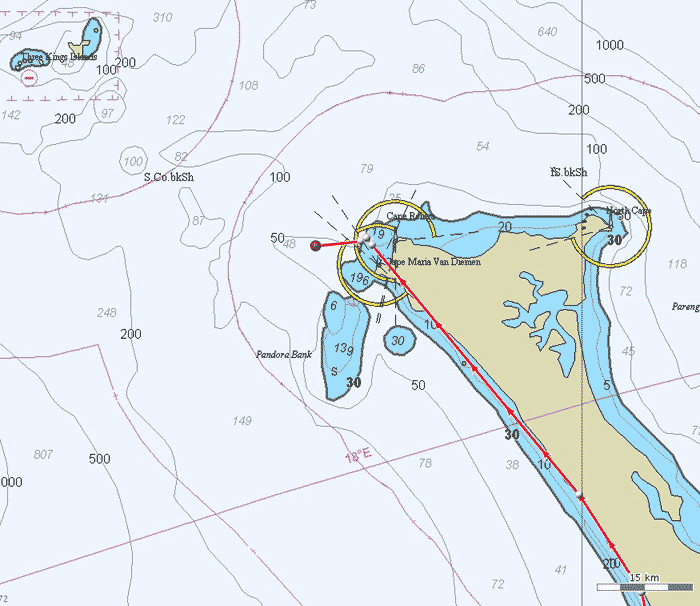
The latest track on Marina was only yesterday (3rd of March) and incredibly she was recorded off the northern tip of New Zealand at Cape Maria Van Diemen! Which means since leaving Hamilton’s Gap south of the Manukau Harbour on the 15th  of February she has covered a minimum distance of 355 km, not including her meanderings in between. Clinton was confident she would be feeding on fish, particularly kahawai, trevally, kingfish, school shark and snapper.

Map generated from Marina's tag showing her movements in Manukau Harbour

Map generated from Marina's tag showing her movements off the Kaipara Harbour

As of yesterday Marina was tracked off Cape Maria Van Diemen at the Northern tip of New Zealand

It was the fifth year running that Clinton has been involved with the sport fishing event which is held each year during Waitangi weekend.  He is co-leader of a research project on great white sharks (Carcharodon carcharias) in New Zealand involving the Department of Conservation, NIWA and the University of Auckland. The primary objectives of this research are to investigate: 

  • Movements of white sharks between New Zealand and the wider pacific.
  • Movements and habitat use within New Zealand waters
  • The use of photo-identification as a means of monitoring the white shark population

In 2007 white shark were listed as a protected species under the Wildlife Act 1953 and DOC is working along side international scientists to learn more about them.  Part of this work relies on assistance from the public for reports of sighting and animals that are hooked on fishing lines. 

Special thanks go out to the Counties Sport Fishing Club, particularly Michael, Ethan and Braden for assisting with the tagging of Marina.  Like the fishermen from Auckland, there are things you can do to help white shark.  The DOC website has some tips on how you can help.

We’re calling on the public to report any sightings of southern right whales along the coastline of New Zealand. So if you see one, let us know!

The fluke of a southern right whale.

The fluke of a southern right whale.

A sighting near the beach at Te Angiangi, in the Hawkes Bay region has signalled the start of this year’s whale migration season and the beginning of the Department of Conservation’s southern right whale research programme.

This is a great opportunity for the public to see large whales on the coast, and also it’s a great chance to help out with our whale research.

The sightings help support the Otago University research programme that is looking into photo identification and habitat use of these animals. 

Scientists get up close and personal with a southern right whale!

Scientists get up close and personal with a southern right whale!

This research is important as it helps us to track the recovery of the southern right whale population, and to better understand the relationship between the whales seen around the mainland and those from the New Zealand subantarctic region.

Data analysed so far by scientists at the University of Auckland, has shown that there have been three matches between the mainland and subantarctic whales. Choice!

The continuation of this research will enable the Department to take measures to ensure the whales have the right level of protection.

They are mostly black in colour and can be identified by their lack of a dorsal fin, a V-shaped blowhole spray, and white growths on their heads called callosities. 

DOC needs to know the date, time and location of the sighting; the number of whales; whether there were any calves; and their direction of travel.

Any southern right whale sightings should be reported immediately on the DOC hotline: 0800 DOCHOT (0800 36 24 68) and recorded using a Marine mammal sighting form.

A couple of southern right whales.

A couple of southern right whales.

Links 

It was Seaweek the other week, and I found in my inbox this Q&A session between a primary school student, and Jonathan Davis, a post-graduate student from Auckland University Leigh Marine Laboratory at the Goat Island Marine Reserve. This came out of some correspondence after a LEARNZ virtual field trip to the Goat Island (Leigh) Marine Reserve.

We thought that you guys might be into reading this, as it’s really interesting! Please leave any comments at the end of the post if you’ve got them, if you have any more questions, I’ll see if Jonathan can answer them for you 🙂

How did you become a marine biologist expert?

Ever since I was little I had a fascination with the ocean, its surroundings, and every little creature that lived inside of it. I grew up about an hour from the ocean in Texas but the water wasn’t very clear. Nevertheless, I used to go swim out in the water and look for anything and everything I could find. After looking at all the creatures I would go home, look them up, and find out as much information about these animals as I could. This trend continued as I got older and went to different places and did different things. In High School I would go to Florida and swim around clear water and see much more. I dove, snorkeled, fished, etc… and every time I did I found something new and learned something cool about it. I did research on the coast of Texas, in Australia, Florida, and now New Zealand. I have taken what I have found and seen and read as much about it as possible to become as much of an expert as I can. There is ALWAYS so much more to learn so I continue as a student to become an expert in what I love the most… Sharks and Rays.

Snorkeling at Goat Island (Lee) Marine Reserve Photo: T & J Enderby.

Snorkeling at Goat Island (Leigh) Marine Reserve Photo: T & J Enderby.

Do you like the animals you work around?

As any marine biologist the big popular animals are always the most fun to swim around and work with. However, all of the animals that I have found and worked around in the ocean have their own place and function. By attempting to understand these less popular animals and seeing how they fit in the big picture I have grown to love all of the animals I work around. For instance, I have an intertidal tank at my house full of all of the little creatures that live along the rocky coasts here in New Zealand: basket stars, cushion stars, shrimp, triple-fin fishes, hermit crabs, snails, slugs, anemones, sponges, and many others… Regardless of the way you look at these creatures the first time, if you study them enough you will learn they all have special features that make them important in the coastal ecosystem in New Zealand.

What’s your favourite animal?

I have shown you that I have grown an appreciation for all of the creatures in the ocean, but my true passion lies with elasmobranchs!!!! Or, SHARKS and RAYS! These creatures fascinate me like no other. They are extremely unique, they play one of the most vital roles in the ocean, and have been around longer than almost any fish in the ocean today. 

Do you like your job?

I love my job. I am still working as a student at the moment but considering I will be doing this exact same thing once I graduate this is technically my job. I want to continue on, do research, and teach at the university level helping other marine biologists reach their goals of breakthrough research and saving the marine ecosystem. Have you EVER met a marine biologist that didn’t love their job? I haven’t. I originally wanted to be a medical doctor… but who goes to the hospital to see the doctor because they WANT to? Everyone wants to go see a marine biologist. It’s just too much fun and every day is different!

Do you get paid well?

Of all the questions you are asking this is the only question that could be a downer. Marine Biologists do not get paid well in comparison to a lot of other jobs. You will definitely be able to support a family and have a stable job if you work hard and find topics that need researching. However, you will not be rich. This is not to say that you can’t become wealthy as a marine biologist. For instance, you could start your own tv show or discover a new species and get all kinds of grants and bonus money. Anything could happen 🙂

A group of Auckland students enjoying the Make a Difference (MAD) Marine programme. Goat Island with the Auckland University Laboratory in the background.

A group of Auckland students enjoying the Make a Difference (MAD) Marine programme. Goat Island with the Auckland University Laboratory in the background

When you were little did you want to be a marine biologist?

This is a great question. When I was little, as I stated before, I thought I wanted to be a medical doctor and save people. However, as I got older I realized that I didn’t know many happy doctors. Most of them had a lot of money, sure, but they didn’t really like going to work because everyone was sick or complaining. In all of the years I have been going to the ocean I haven’t heard a fish, a shark, a dolphin, or any other animal complain!! Have you? I realized eventually when I was at Uni that I liked animals and the ocean way more than people. So, I became a marine biologist. Although I wasn’t sure about it until then I was certain that I had a love for the ocean and its animals growing up. 

Do you have many work mates?

There are quite a few workmates here in Leigh and even more in Auckland. However, the greatest thing about marine biologists is the networking. To successfully continue in the field of marine biology you must know what else is being studied and be able to get your hands on all kinds of research. The best way to do that is to meet people all around the country, read their work, and if you are able to… study with them! By doing this you are making a life-long connection that could help you out a great deal in your future research. So to answer your question simply, YES. There are tons of workmates. Perhaps not always nearby, but always there.

If you do have many work mates do you fight with them?

This is a humorous question. Just like any other job, you will inevitably have certain people you work with that you don’t get along with. However, like I told you earlier… most all marine biologists are doing it because they love it! So, with this in mind… most people are happy and helpful when they go to work or are doing research. So, for me I don’t have and haven’t met any workmates that I fight with. There have definitely been times when a workmate and I feel differently about a certain topic but never has it gotten out of hand and I haven’t had any fights. It’s pretty easy to avoid when everyone is happy. 🙂

Glass-bottom boat at Goat Island Photo: Terry Smith.

Glass-bottom boat at Goat Island Photo: Terry Smith.

When did you become a marine biologist?

When I was talking about being little and wanting to be a marine biologist I stated I always had a love for the ocean and its animals. So, in my heart I became a marine biologist the first time I jumped into the ocean, swam around, and saw the living things inside it. (Around 6 years old)

Why did you become a marine biologist?

My passion for the ocean was really strong since those early years and like I told you I realized I wanted to be happy and enjoy my job once I got to uni. However there was one instance when I was about 12 years old that made it clear in my heart and head. I was on vacation with my family in Destin, Florida and we had a condo room on the 12th floor overlooking the crystal clear ocean. I looked down from my balcony and saw a figure swimming around along the beach. It wasn’t huge but it was definitely not a little fish either. I grabbed my mask and snorkel and sprinted down the stairs!!! I didn’t hesitate a tiny bit. I jumped right into the water with my mask and snorkel and looked for the creature! I eventually got out about 15 meters from shore and there it was… staring right at me. A SHARK! My heart was beating 14109510491 kph. It swam right by me and instead of panicking and swimming away I followed it. I swam behind this shark for at least an hour. I watched its every more. I watched how it went up and down and when its fin came out of the water. I noticed the rows of teeth, the features of its skin, and the size of its eyes. This was the most amazing thing that had ever happened to me. I knew right then and there that I had to know more. I wanted to be in the water with sharks as much as I could. I wanted to learn as much about these creatures as I could and do everything in my power to protect them. So, this is the real reason I became a marine biologist. This fateful encounter with a reef shark along a beach in Florida changed my perception, understanding, and overall passion for life and the ocean forever.

I hope that helps a little bit. If you have any other questions don’t hesitate to ask.

Sincerely!

Jonathan Davis.