A conservation makeover is being planned for the historic Sign of the Packhorse Hut 100 years after building first began.
Continue Reading...Archives For 30/11/1999

In October Canterbury’s rural firefighters tested their skills and strengths in the Rural Firefighter Challenge, set against the stunning Castle Hill basin.
Continue Reading...
DOC staff at Canterbury’s Mahaanui Field Base, used a team-building exercise to bring the Manuka Bay Walkway back to life.
DOC’s Ross Millichamp, Conservation Services Manager / Kaimanatū Matarautaki, explains…

The start of the Manuka Bay Walkway at the Hurunui River mouth
The Manuka Bay Walkway runs from the Hurunui River mouth to Manuka Bay in North Canterbury.
The 5 km long jaunt is typical of many local tracks—highly valued by the local community, who appreciate its coastal vegetation and stunning vistas—but less well known by people from further afield.

Pete Heyward works the scrub bar

DOC Ranger, Tony Woods (Woodsie)
For a number of years the walkway fell into disrepair because access to the Hurunui River end was blocked by a landowner. However the property recently changed hands, and an easement is now in place to restore public access.
This is all well and good on paper, but the reality of bringing an overgrown track back to life was a daunting prospect for local Ranger, Tony Woods.
A call to our neighbours at DOC’s Waimakariri office—who are blessed with a large recreational asset team—secured enough assistance to re-open the walkway, but it was clear that more work was needed to bring it up to standard.
So the idea of a large-scale assault came up. It was branded as a “team-building exercise” but in reality it was a dirty trick to use some of our biodiversity team human resources to tackle the challenge.
DOC Ranger, Alan McDonald, suggested that we make use of his contacts in the local community to bolster the numbers further.

Services Ranger Ian Hankin (left) and three volunteers;
now we will get some work done!
In late August it all came together when 12 Mahaanui team members and six volunteers from Gore Bay, Manuka Bay and Cheviot, tore through the track like a herd of wildebeests, doing more work in two days than Tony Woods could have managed in months.

Staff and volunteers clear a blocked channel and re-open a section of bridging
Although a few finishing touches are needed, the track looks a million dollars and the feedback from the local community has turned from mild criticism (“when are you going to get around to re-opening our track?”) to effusive praise.
Some of our volunteers plan to return to trim weeds and start a pest trapping programme now that access has been restored.
There are far mightier braided rivers in Canterbury, but the modestly sized Ashley-Rakahuri is a taonga of a value disproportionate to its size.
Keen tramper, ornithologist, and photographer Steve Atwood takes us to this ecological gem, just a stone’s throw from Christchurch city…

The world’s most endangered gull — the black-billed gull — nesting on the Ashley-Rakahuri
For the most part the Ashley-Rakahuri weaves through highly modified rural farmland where indigenous natural New Zealand has almost been scrubbed from existence. But the braided river channels of the river itself are a largely unmodified natural environment that has been a unique feature of the Canterbury plains for eons.
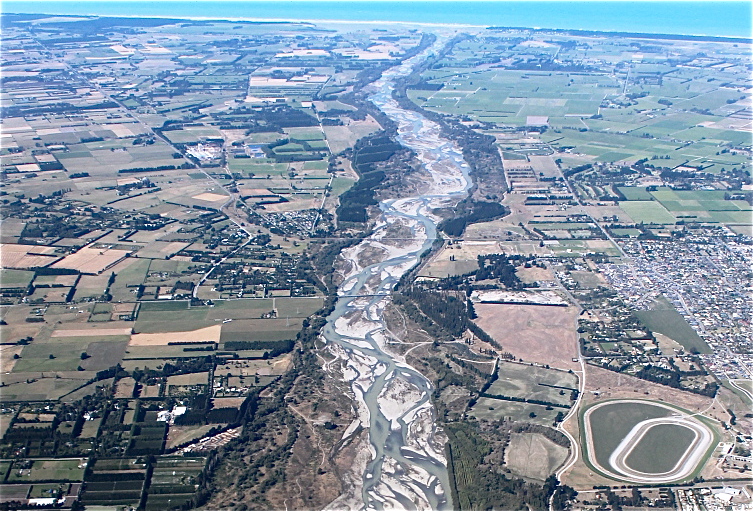
A braided gem. Photo courtesy of Ashley-Rakahuri Rivercare Group
Braided rivers are rare in the rest of the world, with New Zealand considered a hot spot, and Canterbury the centre of that, with 59% of the country’s braided river surface area. They are the home of highly adapted braided river specialists, chief among them being the birds.

Ngutuparore / wrybill — the iconic braided river bird
Among its labyrinthine waterways, dynamic shingle islands and stony banks breed some of the most endangered birds in the world.
In a relatively short span of riverbed quite close to the township of Rangiora nest three of the principle and most threatened braided river specialists: The black-billed gull (the most endangered gull in the world), the unique wrybill (under threat and the only bird in the world with a bill that bends sideways), and the beautiful black-fronted tern (also an endangered species).

Tarapiroe / black-fronted tern — in flight above the Ashley-Rakahuri waters
Where the Ashley-Rakahuri reaches the sea, just 25 kilometres north of Christchurch, it spreads out into a large, generally unmodified estuary that is ranked as an internationally important wetland with a host of resident and seasonally visiting birds.
It is a vital stopover site for birds migrating up and down the coast, and beyond; including the iconic kuaka (bar-tailed godwit) and other Arctic migrants that live out their winter in our summer.

Karoro / black-backed gull chick. Ashley-Rakahuri Estuary
Unfortunately, the ecological values of these braided river systems are increasingly threatened; most have been invaded by introduced weeds and introduced mammalian predators, and are further degraded by a wide variety of human activities.

Male banded dotterel with its chick among the river stones
From its gorge—a popular swimming picnicking and fishing spot—to its mouth, the Ashley-Rakahuri, being so accessible and so close to Christchurch, is particularly vulnerable to these pressures.
The numbers of birds along the river have declined and its ecological rating downgraded accordingly, from ‘outstanding’ to ‘nationally important.’

Safe among the stones? Like the other river breeding specialists, the banded dotterel is a threatened species under risk from human-caused environmental degradation
But, being so small in comparison to the bigger braided rivers, the Ashley-Rakahuri also offers a unique opportunity for effective intervention; initiatives to protect the river in places where the most threatened of birds are known to feed and breed—predator trapping, weed clearance, public education, vehicle discouragement and monitoring—are showing signs of at least stopping the decline of the endangered species, perhaps even reversing it.

Trapping of introduced mammalian predators helps protect these vulnerable tarapiroe chicks hidden among the stones
While the protection efforts at the Ashley-Rakahuri focus on the wrybill, black-billed gull and black-fronted tern, many other bird species benefit.
The braided river is home to such other key native species as the tuturiwhatu (banded dotterel – Charadrius bicinctus), the poaka (pied stilt – Himantopus himantopus) and the torea (pied oystercatcher – Haematopus ostralegus).

Juvenile kaki / black stilt
The very rare kaki (black stilt – Himantopus novaezelandiae) has bred occasionally on the river in recent years (mated with a pied stilt) and over-wintering kaki are regularly seen in small numbers on the estuary.

White-fronted terns share space on the Ashley-Rakahuri with their rarer black-fronted cousins
Migratory wading birds are the spring through to autumn stars of the estuarine environment. Here I have seen godwit, knots, whimbrel and turnstone.
The number of resident species at the estuary is also substantial. Along with the mudflats, dunes, sand and shingle banks are freshwater ponds and creeks, reed and raupo beds, scrublands and grassy flats, providing a multitude of environments for birds to live, breed and feed in.

Tōrea pango / variable oystercatcher. Caught in an estuarine sandstorm
The native birds I have seen along the Ashley-Rakahuri include: the shags (pied, little, spotted and black); the large waders (Australasian bittern, royal spoonbill, white heron and white-faced heron); the intermediate-sized waders (spur-winged plover, South Island pied oystercatcher and variable oystercatcher and oystercatcher hybrids); the waterfowl (black swan, grey teal, New Zealand shoveler, paradise shelduck, New Zealand scaup and Australian coot); the terns (black-fronted, white-fronted and Caspian); the gulls (red-billed, black-billed and southern black-backed); and the birds of the forest, air and riverbank (harrier, welcome swallow, kingfisher, grey warbler, silvereye, and fantail).

Another large white wader that inhabits the estuary — the amazing royal spoonbill

A kurwuwhengi / NZ shoveler drake with a kuaka / godwit in the background

Parekareka / spotted shag can be seen at the Askley-Rakahuri estuary all-year round
The estuary is also home to large number of introduced game birds such as mallard and Canada geese; and introduced field birds such as skylark, chaffinch, yellowhammer, redpoll, sparrow and goldfinch.
The above lists are by no means exhaustive as they are only my observations; other species are recorded as regular, occasional or rare visitors.
This abridged post is from Steve Attwood’s blog. Read the full story (with more gorgeous photos) there.
Thanks Steve for letting us share it here on the Conservation Blog.
I don’t know about you, but I was in awe when I heard about DOC ranger Guy Mckinnon’s incredible Mt Aspiring climb in the news recently (and even more so when I saw a photo of the peak he climbed—it was stupid, crazy, steep!).

Guy McKinnon
It got me wondering just how you get to be the guy (no pun intended) who does that. What path does a person take to become a mountaineering legend? So, for all the wannabe mountaineers out there, I thought I’d ask Guy…
Why/how did you get into mountain climbing?
I started day walking and tramping with my extended family on holidays, that led gradually into the alpine arena and on to mountaineering.
This is a pretty traditional path into the activity. A lot of younger kids today seem to just go straight into the harder side of climbing but, by starting out at the grassroots level, I got a very sound set of traditional outdoor values established early on in my life. I’m proud I still carry these with me!

Mt Crosscut
What/where was your first climb?
My earliest mountaineering experiences were in the Arthur’s Pass National Park. I did instruction there with club groups from the New Zealand Alpine Club (NZAC) and Canterbury Mountaineering Club (CMC), mainly on the peaks between Mount Bealey and Avalanche Peak.

Looking south along the Bealy River, past Mount Bealy
My first really big trip was over the Ball Pass with the NZAC. It was a big adventure!

Ball Pass Crossing: View from East Side Hooker River
What/where is your favourite climb?
I actually don’t have a favourite climb as such, but my favourite mountain would be Mount Sefton.
I’ve had four fabulous climbs on that peak and it has always treated me well.

Mount Sefton, Aoraki/ Mount Cook National Park
How do you approach training and preparing for your big climbs (mentally/physically)?

Climbing the Central Spur of Elie de Beaumont
Unlike the new breed of lifestyle climbers, I don’t do any training or preparation at all. As an amateur climber I am happy to go out and have a crack, other than that I get on with the rest of my life.
Still, like a lot of us men in the circa 40-year age group, a bit of exercise and dietary caution is needed to ward off that beer gut…
Any advice for young people (or not so young people) who are keen to follow in your footsteps?
Get out into the our amazing outdoors and give it a go—nature has already given you everything you need to walk the earth.

Kicking back in the Tian Shan (Central Asia)