Archives For 30/11/1999

 
Fatcat and Fishface: Birdbrain CD (MP3)
The smartest bird in the world is me aha
Lord of the mountains and everything I see aha
To eat I use my curved and scimitar-like beak aha
To break into your cars I do not a key aha
Kea, kea, kea, cleverest of all

Dangerous tucker – nibbling on twisties is bad for a kea’s health – the food is unnatural and the car park is not a good placeto be when cars are backing out!

My seven-year old son has decided that his next birthday will be a kea party. He tells me they are his second-favourite bird; after kiwi of course. A recent visit to Arthur’s Pass cemented this amour – his request of seeing a kea was fulfilled with a stop at the Otira Gorge car park. We watched (and played catch with) four kea that were checking us out as much as we were them! While we were there, cars came and went, took photos – threw their lunch onto the asphalt – then left again. Despite all the signs and brochures, people still can’t resist feeding these cheeky beggars – the car park was littered with bread and lunch-wraps.

William and kea check each other out – each as curious as the other!

Turning a child’s interest into action is the next challenge for a parent wanting to raise the next generation of environmentalists. Luckily for us, and for kea, The Kea Conservation Trust offers lots of opportunities for families like us to get involved.

The trust is about to launch into their annual winter kea survey. Anyone can do it; it’s as easy as downloading a survey form from their website to take with you when you venture into kea country, filling it out and sending it in. You can conduct your counts on as many (or as few) Saturday and Sunday afternoons (anytime for as long as you like between 12pm – 4.30pm) throughout July.

What a great reason to escape the Christchurch quake zone and head into the Southern Alps.

Josie’s rock-hopping antics are of great interest to a curious kea.

For those that want to learn more, Tamsin Orr-Walker, Chair of the Kea Conservation Trust, is giving talks at the visitor centres in Arthur’s Pass and Aoraki / Mt Cook National Parks. She will be in Aoraki/Mt Cook on 1 July, and in Arthur’s Pass in Sunday 3 July.

Find out more on their website: www.keaconservation.co.nz

How much time do you have for kea?

If you have 15 minutes

Purchase a calendar, card or DVD from the Kea Conservation Trust shop; all proceeds support their kea projects.

If you have 1 hour

Listen to a talk given by Kea Conservation Trust Chair Tamsin Orr-Walker; on Friday 1 July in Aoraki/ Mt Cook or Sunday 3 July in Arthur’s Pass.

Check out the Kea Conservation website for other locations.

If you have 5 hours

Take a walk in the Southern Alps and fill out a kea survey form if you spot a kea.

If you have 5 days

Visit some places that people and kea clash like ski fields and national parks. Pick up rubbish and talk to people about why they shouldn’t feed kea.

If you have 1 month

If you have Microsoft Publisher, you could help the Kea Conservation Trust with producing their annual newsletter.

If you have 1 year

Volunteer for one of the three positions advertised on the Kea Conservation Trust website; treasurer; regional liaisons or volunteer co-ordinator.

Warren Chinn, our invertebrate ecologist in Canterbury Conservancy, was lucky enough to be invited on a trip to the Kermadec Islands last month. The 20-day expedition, led by Dr Tom Trnski, marine curator at Auckland Museum, aimed to explore the remote islands for new species. Warren filed this report on his return…

…We tend to form mental pictures of new places based on prior knowledge, other people’s comments, pictures, maps and to a large extent, imagination of ‘how it should be’.

My mental image of the Kermadecs was a scene of romantically isolated semi-tropical lost worlds, the stuff of Joseph Banks and La Peruse. Sea sickness immediately erased such nonsense within hours of leaving Tauranga.

Our vessel: The Braveheart at Tauranga.

Our vessel: The Braveheart at Tauranga.

Our first sighting of the Kermadec group was L’Esperance Rock, a mutilated knuckle of basalt erupting from the heaving ocean. It was better than my imagination – a good start.

L’Esperance Rock comes into view, after two days.

L’Esperance Rock comes into view, after two days.

We steamed past as it was too rough to land and over the following days three more islands in the chain slowly came into view, these were; Cheeseman, Curtis and Macauley.

Each island seemed to me like a massive billboard in the ocean, with an explicit natural history message: “HOW DID THIS HAPPEN?” Followed by two smaller messages: “when did this happen?”, and “what lives here and from where?”

Petrels fill the air above South Meyer Island.

Petrels fill the air above South Meyer Island.

We anchored near Raoul Island, where I landed on the Meyer Island group with (the very erstwhile) Peter de Lange.

The Meyer islands are steep-sided, clad in a dry, friable soil that is shot through with Petrel burrows. An equal number of birds fill the sky, forming a constant blizzard of flapping and diving.

Here was another ecological message: This is what mainland coastal New Zealand would have been like prior to our arrival and the introduction of mammalian predators. These Islands are a nature reserve of the highest value and this is clearly why – they are well-insulated.

Petrel burrows on North Meyer Island.

Petrel burrows on North Meyer Island.

The insect fauna on the small islands comprised big headed ants, flies, crickets, leaf hoppers and small moths. Spiders were common and small in size, which probably reflects their arrival on the islands by ballooning, that is, travelling through the air on filaments of silk. Centipedes and millipedes were also present, along with mites and silverfish.

The next week I spent four days on Raoul Island, a proper volcano with a crater lake. After a lovely evening with the DOC staff and volunteers, I tramped over to Denham Bay to collect invertebrates there. Here I set up a malaise trap and collected numerous moths, flies and even spiders.

The most interesting find was a large wolf spider, Geolycosa tongatabuensis, a species that occurs from Tonga to Northland. These spiders represent the invertebrate situation on the Kermadecs, the fauna is composed of a mixture of pacific island and northern New Zealand elements, which makes sense biogeographically.

It is clear that cyclones, drift wood, ocean currents and air systems all carry invertebrates within and between land masses in this part of the globe.

A wolf spider found between Northland New Zealand and Tonga.

A wolf spider found between Northland New Zealand and Tonga.

We left Raoul Island and anchored at Macauley Island. Here Peter and I spent two nights. The foot travel was difficult as moving through the chest-high Kermadec fern and Cyperus grass was like step-plugging in deep snow.

However, I collected more crickets, moths, beetles and spiders. I even saw a yellow admiral butterfly but was unable to catch it. Butterflies no doubt get blown to these islands frequently so there will always be some present.

Landing on Cheeseman Island.

Landing on Cheeseman Island.

We then steamed to Cheeseman and Curtis Islands. These two are active hotspots on the earth’s surface and this was obvious by the smoke coming from Curtis Island.

We landed on Cheeseman; a strange, almost lunar landscape. The most exciting find was Senecio kermadecensis – a plant endemic to the island – which had Peter very excited. I collected spiders, flies, beetles and crickets.

A Solomona cricket on Esperance Rock.

A Solomona cricket on Esperance Rock.

Our last landing was L’Esperance Rock which was a little hair-raising. A steep pile of volcanic rubble best describes this Island.

However I found two species of pseudoscorpion, numerous crickets and another wolf spider species on the rock. The pseudoscorpions probably got onto the rock via birds, as they are flightless and wouldn’t survive on flotsam. L’Esperance Rock was the very last place I expected to find pseudoscorpions, so there it is; reality was more creative than my imagination.

Peter on the summit of Esperance Rock.

Peter on the summit of Esperance Rock.

You can find out more by visiting the expedition pages on the Auckland Museum website.

What do you get when two musicians are sent in song-writing exile to the scene of one of New Zealand’s largest volcanic eruption? You get a crackling new album rising from the ashes.
 
In 2010 Billy Earl (Andy Hummel -The Woolshed Sessions, Rhian Sheehan) and Betty Grey (Holly Jane Ewens) of Wellington folk duo ‘Rosy Tin Teacaddy’ spent six weeks on the shores of Lake Tarawera. The duo were the recipients of the Wild Creations artist in residence programme, a joint venture between the Department of Conservation and Creative NZ. They set out to research, write and record their translations of local history and isolation in a site-responsive manner.
Temporary recording studio - Lake Tarawera

Temporary recording studio - Lake Tarawera

The result is a work that explores the lead-up to, and aftermath of, the 1886 eruption of Mount Tarawera and subsequent loss of the self-appointed eighth wonder of the world – the Pink and White Terraces.

Rosy Tin Teacaddy have made use of historical anecdotes and found sounds (while holding fast to their harmonic and word-wizardry roots), in their new full-length release All Mountains Are Men. Presented with hand-numbered booklets, the album extends the duo’s artistic concept beyond the audio as they translate stories of the past into a present-day archival treasure.

Album cover - All Mountains Are Men

Album cover - All Mountains Are Men

The BATS theatre show, ‘Coffee Cups and a Porridge Pot at Frying Pan Lake’ gave audiences a taste of this experience in May 2010.

Forthcoming single Telegrams and Ashes, uses snippets from newspapers of the day with a dedication to the local telegraph master. Sitting on a bed of backwards guitar and finger-clicks there is little to suggest this album is merely two folkies strumming away in the back-blocks.

Playing on location - All Mountains Are Men

Playing on location - All Mountains Are Men

There is cheek amongst the ruins too, with songs like Blow Your Top where the duo imagine the lake and mountain flirting with one another in a present context—’Facebooking, perhaps’, while the lament Beauty, My Dear swells with loss and hope—’Can’t have a clear sky, without a frost/Beauty, my dear comes at a cost’.

Simultaneously cinematic and intimate, this album is layered as deep as the lake bed and seeks to provide fans with a slow burner through the cold winter months ahead.

All Mountains Are Men will be released with a blessing by local kaumatua at Lake Tarawera on June 10, in conjunction with the 125th commemoration of the eruption of Mt Tarawera. This will be followed at 7pm by a concert in the stunning historic Rotorua Museum of Art and History.

 Album release venue - Rotorua Museum

Album release venue - Rotorua Museum

The following evening, Saturday June 11, Rosy Tin Teacaddy will play at the Buried Village, Te Wairoa, Lake Tarawera, joining Cornel de Ronde (GNS Science) as he shares his findings of recent exploration of the Rotomahana lake bed and the discovery of remnants of the Pink Terrace.

For both these evenings, bookings are advised. Contact the Rotorua Museum (07) 350 1814, or the Buried Village (07) 3628287.

Rosy Tin Teacaddy will be touring All Mountains Are Men throughout the country with Bond St Bridge (AKL) who is also promoting his new album, Spring Summer Awesome Winter.

For more on Rosy Tin Teacaddy and their full line up of shows check out their Facebook page.

In today’s economic climate it’s getting harder to achieve all the conservation challenges facing us. DOC’s way forward is in developing relationships with communities and businesses to help achieve our conservation goals. So it’s great when local businesses offer a helping hand.

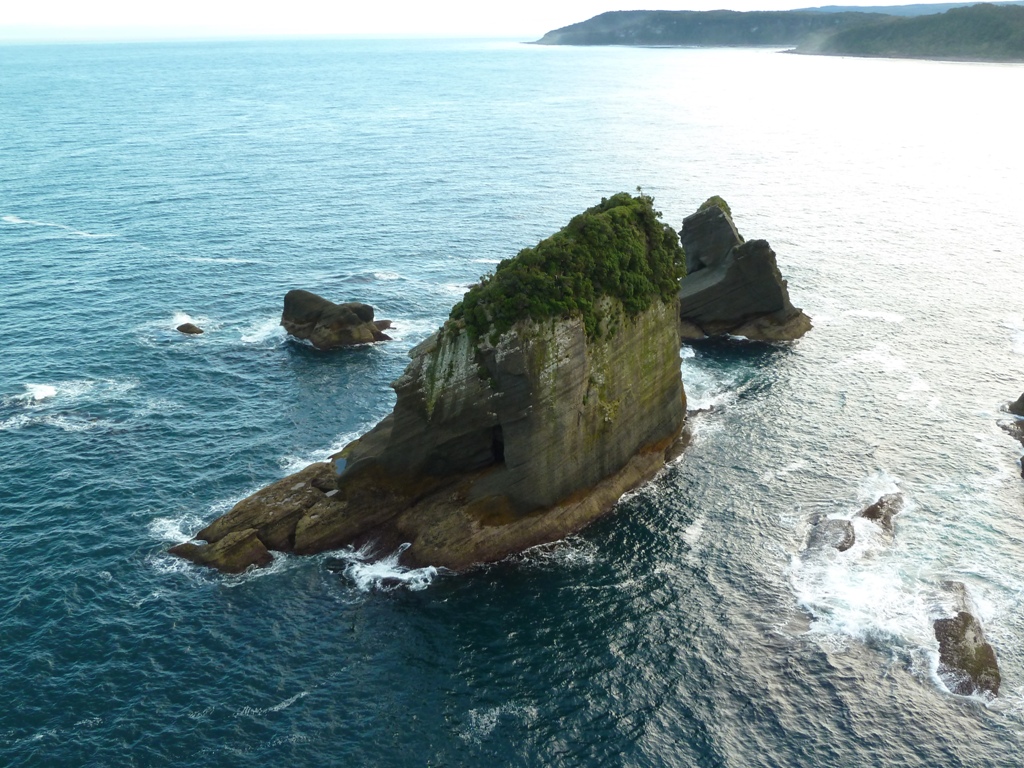
Here in South Westland the Biodiversity Team got a boost when Local Helicopter operator Michael “Clutch” Glynn of Mountain Helicopters donated over $6000 flying time to threatened species protection. Thanks to Clutch’s generosity we’ve been able to improve our knowledge of a recently discovered population of skinks and unearth some rare land leeches on a coastal rock stack.

Boy’s team pick up from the razor back ridge of a West Coast rock stack

Last year DOC Marine expert Don Neale made an unexpected discovery of skinks basking on a small, vegetated rock stack  during a survey of islands and stacks along the West Coast Tai Poutini coastline. This was a pretty significant find, as the only other lizards known to live on West Coast islands are the endemic Taumaka skink (Oligosoma taumakae) and gecko (Hoplodactylus “Open Bay Islands gecko”). These are two of the rarest lizard species in New Zealand and they’re only found on Taumaka me Popotai (Open Bay Islands).

How many basking skinks can you count?

The Mountain Helicopters donation gave us a chance to get back this summer with lizard expert Marieke Lettink to find out what species these skinks are. They could be related to the Taumaka skink or the cryptic skink (Oligosoma acrinasum) found on the mainland, or maybe we have found a new species altogether….

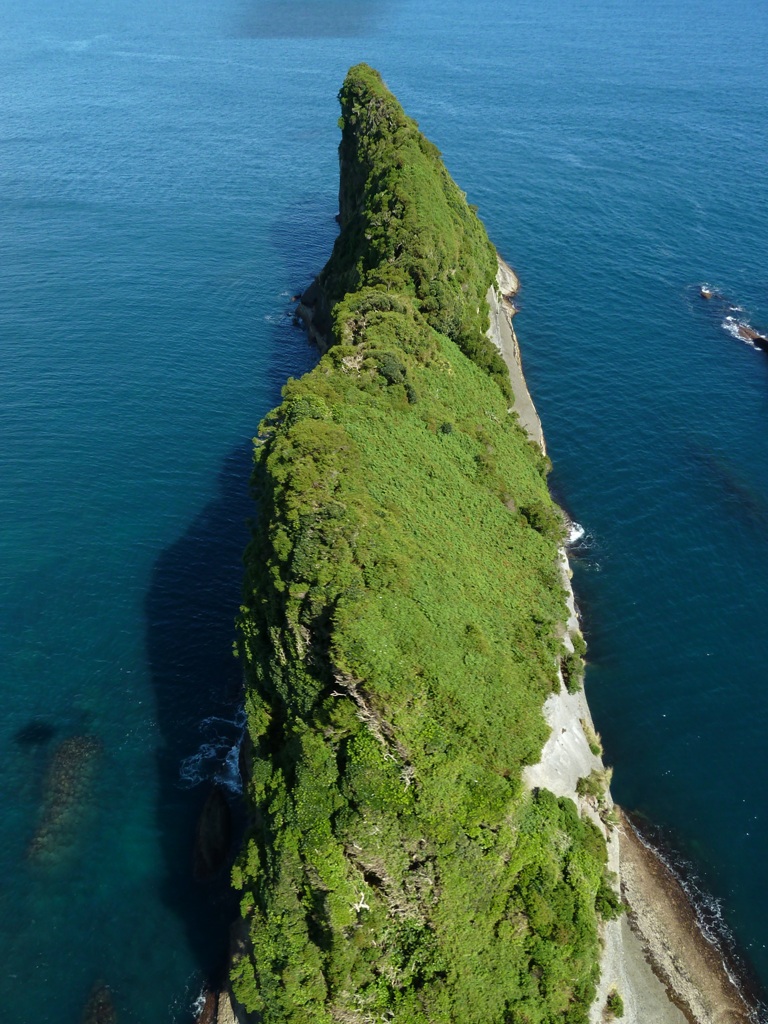
Getting out there was a bit hairy, as the stacks are very steep and skinny and we were thankful for the skill and experience of pilot Nathan Healey in depositing and removing us safely.

Flying over the larger stack

In a bit of a battle of the sexes Marieke and I, pitted our lizard wrangling skills against the boy’s team, Programme Manager Gareth Hopkins and Ranger Jeff Rawles, on a larger neighbouring rock stack. I have to admit the girls had a head start as we already knew there were skinks on our island.

Small West Coast rock stack from the air

Mostly we caught the skinks using cage traps baited with tinned pear, but Marieke with her lizarding superhero skills caught a few by hand. We got very excited when the boys radioed to say they’d spotted skinks on their stack too!

Herpetologist Marieke Lettink takes care not to lose this slippery skink as she extracts it from the trap

Although their home is restricted to 2 very small island stacks the population seems to be doing really well. We saw lots of juvenile skinks as well as the adults, so they’re definitely breeding.


Juvenile skink

Once a skink was caught we weighed and measured it and took diagnostic photos of scale patterns to get an idea of how this population fits into the skink family tree.

A skink in the bag is worth 2 in the bush: DOC ranger Rebecca Wilson weighs this one

Based on physical appearance these skinks look like they are related to Taumaka skinks. There were some differences though, so we’re waiting for the results from analysis of tail tip DNA samples to see if they are the same species. 

Adult skink

 Given the thriving skink population and the difficulty of access from the shore it’s likely these islands are predator free. The boys ran rodent tracking tunnels overnight and didn’t detect any mice or rats. This is great news! Vulnerable species like lizards don’t have good prospects on the mainland with mice, rats, stoats, cats etc etc…

There was more excitement to come as we settled down in our precarious camps for the evening. As dusk fell hundreds of fairy prions returned to roost, and as we were probably sitting right on top of their houses they tried to roost in our laps and on our heads! While suffering this feathery onslaught Jeff lifted his pack up to find some leeches underneath.

DOC ranger Jeff Rawles settling down for a precarious night's sleep

Most leech species live in fresh or saltwater environments, but some are adapted to life out of the water. Very few land leeches have been discovered in New Zealand and with the single exception of a specimen found under a log in Fiordland they have only been observed on islands (Snares, Solander and Taumaka). The Taumaka leech (Hirudobdella antipodium) is only known to live on Taumaka Island and hasn’t been seen since 1995, despite extensive searches. Weka introduced to the island early last century probably eat the leeches and that’s a worry for the survival of this population.

Although the boys found them crawling on their faces during the night these leeches didn't try to bite

New Zealand’s land leeches are believed to feed on seabird blood, so it’s not surprising that the boys saw them coming out just as the fairy prions came back to roost. Or that Gareth had a couple crawling over his face after evicting a prion from his bivy bag. New Zealand leeches are a bit of a mystery and it’s exciting to think we might have re-discovered the endangered Taumaka leech.

We don’t tend to have spare money floating around to check out new discoveries, so it’s great that Clutch’s generous donation of helicopter time and Nathan’s awesome flying skills made this out of the ordinary trip possible. When people come together with a common vision of protecting our special species and environments we can achieve fantastic results.

Mountain Helicopters pilot Nathan Healey susses out a spot to land on the small stack

 For the record the girls won on skinks caught by 21 skinks to 2!

There’s nothing like a Royal Wedding to get us girls dreaming about our own Prince William Charming. Sigh.

We all need a little romance in our lives – some of us more than others. And those of us who spend time in the outdoors in our parks and other places know just how special and mood-enhancing these places can be. So, why not make it official boys? Take us out in the wilderness, get down on one knee and make us feel like a princess. Here are my top spots in Canterbury for a proposal with a fairytale ending…

Castle Hill – Kura Tawhiti Conservation Area

Getting there: Drive west of Christchurch for about 80 minutes

Castle Hill has plenty of hidden corners for a romantic tryst

Come on – it’s got Castle in the name – it has to be good! Even without the cliché connection this is a fantastic spot – the stone outcrops that earned its name make it an awe-inspiring place to visit. And it’s amazing how you can get lost in this place – there can be 20 cars in the car park but in the reserve itself you can wander around unnoticed for hours; plenty of hidden corners for a romantic tryst.

Kura Tawhiti is a topuni site – history tells it was claimed by the son of celebrated chief Tuahuriri so that he could gather the green glowing feathers of kakapo in the area for his daughter Hine Mihi to wear (Aotearoa’s own royal fashion).

Learn more about Castle Hill – Kura Tawhiti Conservation Area

Millennium Walk – Arthur’s Pass National Park

Getting there: Drive west from Christchurch for about 2 hrs; the walk is only 10 min return.

Wintertime at "Chapel of the Snows"

A marvellous spot for a midnight proposal – the walk goes up behind the quaint Arthur’s Pass ‘Chapel of Snows’ to a viewing platform overlooking the Avalanche Creek Waterfall, which is lit at night. In the middle of winter, snow and icicles hang like glistening diamonds and frosty air requires lots of close cuddles. Plus, when you are ready to throw your own Royal Wedding, the back window of the chapel gives a view directly onto the waterfall – bringing the proposal and the ceremony together to make memories that last a lifetime.

A frozen waterfall and snow covered rocks at Avalanche Creek, Arthur's Pass National Park provide the perfect backdrop for romance

Learn more about Millennium Walk (and other short walks around Arthur’s Pass National Park) 

Mt Sunday – Hakatere Conservation Park

Getting there: Drive south then west to Mt Somers township then into the Ashburton Lakes, past Lake Clearwater; about 2 ½ hrs from Christchurch.

Lord of the Rings fans will know this lump of glacial rock as the capital of Rohan and home to Meduseld, the hall of King Theoden and his niece Éowyn. So we have rings, we have princesses and kings – we have a small hill to climb, which makes us all feel good when we reach the top. Apparently true Tolkein enthusiasts get dressed up into costumes to make the climb – that’s optional although very cool – and lets face it Éowyn’s white dress would grace any Princess bride.

Learn more about Mount Sunday

Mt Princess – St James Conservation Area

Getting there: St James is behind Hanmer Springs – this climb starts near Lake Tennyson, a further 45 km along Tophouse Road (shingle).

For true backcountry mountaineers who prefer to feel “on the top of the world” before making a life-changing decision like marriage, then Mt Princess must be for you (yes again, a corny name). This climb (2126 m) starts from near Lake Tennyson, which also has romantic connotations. Alfred Tennyson was Poet Laureate during Queen Victoria’s reign and is in the top ten of most quoted writers; including the phrase “Tis better to have loved and lost / Than never to have loved at all”. So once you and your true backcountry love reach the top, quote her some poetry and gift her a rock.

Learn more about St James Conservation Area

What would be (or is) your preferred proposal spot? I’d love to hear from you…