Archives For 30/11/1999

Raoul Island is one of the Kermadec Islands, about 1000km north-east of New Zealand in the South Pacific Ocean. DOC have a small team of staff and volunteers who live on the island in relative solitude. Their main focus is controlling weeds on the island, maintaining infrastructure such as buildings, roads and tracks, and carrying out work for Met Service and GNS.

Since the island is so remote, we get these diary entries from the team and post them up on their behalf. Today’s diary is by volunteer Helen Kay.

A world away

Having been accepted in to the Raoul weed programme as a volunteer, I had a matter of days to organise a flight over to New Zealand from the UK. I knew living and working on a remote island such as Raoul would be different in every way from my usual lifestyle in a city in northern England and it has not disappointed.

The hostel veranda in the sun.

Where we relax after a hard day’s weeding – the hostel veranda in the sun

After spending a week packing gear and training at Warkworth, we departed for Raoul on the Braveheart. Three nights of large swells, the unending feeling of nausea and the constant dread of someone being sick near me certainly made the trip memorable.

We’re here!

Dry land and the warm reception of the team lifted my spirits no end. Having amenities such as a fully equipped kitchen and bathrooms undoubtedly made it easy to settle quickly into island life.

Having said that, there are numerous aspects to living here that are very different from back home; having to keep track of our food usage for example. We are currently left with one tin of mushrooms and are saving it for a recipe deemed worthy. Cooking here is fun, we have to use what’s available whether it be from Arkwright’s (our food store) or from one of the hostel vegetable gardens. Tinned peaches seem to make a common appearance in a lot of meals.

A curious young masked booby looking at us.

Who’s looking at who? A curious young masked booby looking at us

What do I do?

Every week day we walk into the bush and search for alien plant species such as black passionfruit and peach. A large majority of the weeds we find are seedlings, but when you’re the person who happens upon that massive adolescent mysore thorn, it’s very satisfying. Competition does arise when it comes to weeding; it keeps us motivated on those more challenging days.

Very little of Raoul is flat so many of our weeding days are spent traversing (slipping and sliding) across steep gullies and swathes of wind-fallen trees. Naturally this earns some people (including myself) an impressive repertoire of cuts and bruises as well as that well-deserved home brew at the end of the day.

And the weekends?

Weekends provide ample time to do what you want, whether it be walking over to Denham Bay or one of the other huts, relaxing around the hostel, or brewing beer in the Rat & Tui Brewery. When we’re able to, snorkelling is definitely one of my favourite past times on the island.

The view of the crater from Mt Moumoukai.

The view of the crater from Mt Moumoukai

The best bits

It’s awesome living and working in a nature reserve. Being able to boat over to the Meyer Islets is extremely rewarding. Standing in a colony of Kermadec petrels with their tiny chicks or having a masked booby walk up to you completely unafraid are both amazing experiences.

I’m really enjoying learning about the flora and fauna of Raoul, especially the birds. The one exception is the pukekos between four and seven in the morning when they’re at their loudest!

All the new experiences here have impacted me positively in every way. We are half way through our six months here and there is still so much to see and do.

2012 Living Legends planting events start soon. Register now for an event near you – it’s free!

In 2011, to celebrate New Zealand’s hosting of Rugby World Cup, 17 Rugby Legends joined thousands of volunteers to plant 83,000 native trees throughout New Zealand. 

This year, Living Legends is returning to 17 locations to plant another 45,000 trees. 

Living Legends is a community conservation project that was set up in 2011 to leave a legacy of New Zealand’s hosting of Rugby World Cup.  It’s a five year project and the target is to plant 170,000 trees before the end of 2015. 

Each planting project is dedicated to a regional ‘Rugby Legend’ who was selected in 2011 by their provincial rugby union. These Rugby Legends are people who have made an outstanding contribution to rugby in New Zealand. 

Living Legends is a joint venture of Project Crimson, an environmental charity with 20 years experience in community-based native restoration projects, and The Tindall Foundation.

DOC has been a partner of Project Crimson since 1990 and we are thrilled to be a major sponsor of Living Legends, along with Meridian Energy. 

All of the sites where Living Legends are planting, aim to have a positive and lasting impact on the social, economic and environmental value of its unique location.  DOC helped Living Legends to select appropriate public spaces for these plantings to ensure that all New Zealanders can enjoy them for years to come. 

Living Legends plantings will enhance some of our most special parks and reserves throughout New Zealand. These are places where we reflect, refresh and can escape the hustle and bustle of our daily lives.

It’s not long until the planting events start for 2012 so the team at DOC are getting our spades ready and hope to see you there! 

The following Rugby Legends will be at the events in August to play their part in helping us plant over 45,000 native trees and shrubs.

  • Sir Colin Meads will be in Taupo
  • Tane Norton will be in Christchurch and Ashburton,
  • Kevin Laidlaw will be in Invercargill,
  • Duane Monkley will be at Lake Areare in the Waikato 
  • Ian MacRae will be at our Napier event,
  • Ian Eliason will be in New Plymouth,
  • Richie Guy will be at our Whangarei event,
  • Kees Meeuws has confirmed for Dunedin
  • Sam Strahan will be in the Manawatu. 

Register for an event near you at www.livinglegends.co.nz. We look forward to seeing you there!

By Dave Houston

Mid-winter opportunity to work on Chatham petrel burrows

In early July each year a small group of DOC workers head out to Rangatira or South East Island in the Chatham’s to undertake end of season work on the Chatham petrel burrows.  This year we decided to give Chatham Island school children an opportunity to join us and experience the magic of Rangatira.

Rangatira Island

Rangatira or South East Island

We were joined by Year 11 Correspondence School students Harriet Graydon and Mia Foley, both of Pitt Island, along with Chatham Islander Jacob Hill, a Year 12 student at St Bedes College, for the 4-day trip. 

After completing quarantine procedures designed to keep the islands pest-free, we caught an early morning fishing-boat ride from the main island to Pitt, to pick up Mia and Harriet.  After a brief stop and exchange of mail and supplies, we departed for the forty minute trip to Rangatira.

The landing

Landing on Rangatira

Rangatira residents

No jetty means a bow landing on the rock platform and a frantic passing ashore of the buckets containing our food and gear, but the team handled it flawlessly. 

As soon as we were ashore we bumped into our first special species, the shore plover.  Once abundant around the coasts of New Zealand, this plucky little shorebird was eradicated by rats and survived only on Rangatira.  Fortunately, it has now been returned to several mainland sites.

Chatham Island black robin

Chatham Island black robin

While hauling the buckets up to the hut we bumped into our next special resident – the black robin.  With around 200 birds, Rangatira is the stronghold for the species and over the next few days we got to see quite a few as they jumped out of the forest at us in anticipation of a mealworm handout.

After settling in we fitted everyone out with petrel boards – special footwear designed to prevent us collapsing seabird burrows as we walked around the island.  We then set off on our main task, checking 250 burrows of the endangered Chatham Island petrel

After checking that this years chicks had successfully fledged (and unfortunately a few didn’t), we did a bit of housekeeping and then put a barricade in front of the entrance to stop other seabirds taking up residence while the petrels are away over the winter.

Checking chatham petrel burrow

Mia, Harriet and Jacob checking a Chatham petrel burrow

While wandering around the forest for a few days we got the opportunity to see more island residents – including the Chatham Island species of snipe, parakeets, tui, tomtit, warbler and skink. 

On our first night we hoped to introduce the visitors to the many seabirds and abundant invertebrates that call the island home.  Unfortunately, the great weather and full moon kept all the seabirds at sea so we had to be content listening to blue penguins braying in the forest.

Petrel boards

Fancy footwear: Petrel boards reduce damage to the many seabird
burrows in the forest floor

Reluctant return

All too soon it was time to pack up, lug the gear back to the landing and await the arrival of our ride.  Our skipper Glen King treated us to the scenic route on the way home, travelling around the bottom and up the western side of Pitt Island, taking in views of Mangere and Little Mangere Islands on the way as well as taking us into an impressive sea cave.

Rangatira view

Harriet, Mia and Jacob enjoying the view from the summit of Rangatira.
Pitt Island in background

Mia and Harriet’s  families were waiting on the wharf at Flowerpot when we arrived, glad to see their kids home safe and just a bit jealous of the experience.  Jacob had to endure another hour-long crossing of Pitt Strait before he could head home, but the experience can’t have been to bad as he wants to come back when we open up the petrel burrows again in November.  I think he’ll have some competition, as the girls want to go too.

Trip home

Jacob and Harriet enjoying the trip home along with
Ranger Juzah Zammit-Ross

by Anna McKnight, DOC Community Relations Ranger

The famous Trout Centre ‘fish outs’

The Tongariro National Trout Centre is world famous in the central North Island for its kid’s fish outs.

One on one time with volunteers crazy about fly fishing

Fishing for your first trout with a volunteer angler is a big part of local identity – you catch a trout at the children’s pond when you are young, and then grow up and go on to take your own children and grandchildren.

Kids fishing – an intergenerational affair

Tongariro Trout Centre Society president Rob Lester explains, “I think we are the luckiest volunteers when you see the delight on the children’s faces”.

There are seven fish outs a year that attract up to 200 children at a time and bring visitors in from out of town.

Local kids catch their first trout on kid’s fish out days

Tongariro Trout Centre Society

The Tongariro Trout Centre Society was incorporated in 2001 to develop, promote and expand the Tongariro National Trout Centre. In partnership with DOC and Genesis Energy, the Centre has become a place that not only promotes the Taupō Fishery, but is also a leading advocate for freshwater conservation.

Volunteers with Genesis Energy on sharing the river

History of the Tongariro Trout Centre

The land was originally gifted from the Downs family and in 1926 a trout hatchery was established. The site was chosen for the purity and temperature of the water from the Waihukahuka spring and stream—cool, clear and clean.

Blue Gold – interpreting the importance of freshwater

In 2003 the River Walk building was opened to help promote the Taupō Fishery.

The Taupō for Tomorrow education programme classroom was built in 2006 and named after the late kaumātua, Whakapumautanga Downs.

2011 saw the opening of the Genesis Energy Freshwater Aquarium where you can get an up-close and personal experience with many of our native species such as kōkopu and kōaro.

The visitor centre was also upgraded with interpretation that includes a 20 minute film and a series on freshwater conservation titled ‘Blue Gold’.

Whio/blue duck

Whio (blue duck) can now be seen from the grounds of the Tongariro Trout Centre due to a local collaborative effort on predator trapping. It has hosted Whio Family Day for the last three years.

More than a trout on the end of the line

It is exciting to see the Tongariro Trout Centre not only giving us the buzz of a trout on the end of our line, or even bringing us face to face with a kōkopu or whio for the first time, but leaving us with a deep understanding of the importance of clean freshwater for our future.

The children’s pond in action

Working together, in partnership with our volunteers, is fast tracking us towards our dreams and goals to preserve our freshwater for future generations.

Every Friday Jobs at DOC takes you behind the scenes and into the jobs, the challenges, the highlights, and the personalities of the people who work at the Department of Conservation.

Today, to celebrate our amazing conservation volunteers, we shine the limelight on volunteer David Roscoe…

Name: David Roscoe

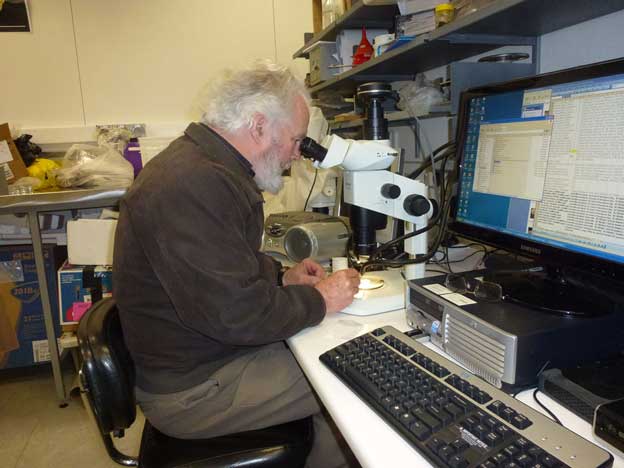
Position: Volunteer, imaging tiny objects in sharp focus. Three half-days a week, usually in the level two laboratory at DOC’s National Office.

Dave in DOC’s old lab at Victoria University

What kind of things do you do in your DOC volunteer role?

Photographing small objects in sharp focus, by merging numerous images taken at different foci using very cold light (otherwise the shell melts or is vaporized).

Producing snail posters and snail identification CDs. Snail surveys and identifying snails for DOC staff. Producing a toolbox for snail inventory and monitoring.

Left: Kokopapa unispathulata from Kaikoura. Middle top: Allodiscus from Wainuiomata. Middle bottom: Aeschrodomus stipulata from Kaka Point. Right: Liarea ornata from Matakana

What is the best part of your work?

Working with DOC staff in a pleasant working environment and receiving leaf mould containing snails from unusual locations.

What is the hardest part about your work?

Separating pictures of hairy snails and beetles from their background, pixel by pixel.

Dave looking at a tiny (pin prick-sized) still un-named snail species under a microscope. This snail was found on Great Mercury Island

What led you to your role in DOC?

Meeting inspiring people, then opportunity to pursue a long-held interest in landsnails (since 1964).

What was your highlight from the month just gone?

Very positive feedback about a poster and a quantitative snail survey I had done for, and on, Hen Island.

The rule of three…

Three loves

  1. My supportive wife Jenni.
  2. Advertising our huge diversity of small native land snails. So far over 460 species have been named with an estimated total of 1200–2000. Most are small – under 3 mm – and easily overlooked. In relation to area we have one of the most diverse land snail faunas in the world – compare this with Great Britain (of similar area) with 220 species. Also, at some localities over 60 species have been found living together, twice the highest diversity recorded anywhere else.
  3. Playing classical piano music, currently mostly Russian.

Three pet peeves

  1. Doing little about overpopulation.
  2. Tall poppy syndrome.
  3. Reflex green-bashing.

Three foods

  1. Homemade bread.
  2. Wellington’s sophisticated food variety.
  3. Jenni’s cooking.

Three favourite places in New Zealand

  1. Hen Island at dawn (dawn chorus).
  2. A grassy hillside patch surrounded by bush in the Wakarara Range near Hastings.
  3. The stunning beauty of much of the Wainuiomata Waterworks Reserve!

Favourite…

  1. Movie: The Warriors (Ancient Greek saga, set in today’s New York gangs).
  2. Album: Complete Piano Works of Federico Mompou.
  3. Book: Fredric Brown, Nightmares and Geezenstacks (SF mostly)

Dave in the lab checking out a new species of snail

Deep and meaningful:

What piece of advice would you tell your 18 year old self?

Forget pharmacy (from which I am now retired), go to university – the student talent is awesome and you are much less likely to get armed holdups.

And, laugh more.

Who or what inspires you and why?

My piano teacher, she just scored a QSM. She is patient with my foolishness. Also, most of the DOC staff, hardworking and passionate about their work.

When you were a kid, what did you want to be when you grew up?

Invisible.

And now, if you weren’t working at DOC, what would you want to be?

Working as a DOC volunteer.

What sustainability tip would you like to pass on?

Many sustainability problems relate to population levels. Individuals cannot solve overpopulation on their own. We could encourage politicians to include population optimisation in their manifestos.

Which green behaviour would you like to adopt this year – at home? At work?

  • At home, trenching or composting garden and food rubbish.
  • At work, always turning off unneeded lights and somehow being able to switch off the exhaust fan when absent.

If you could be any native species for a day, what would you be and why?

A kākāpō, being indulged and well looked after in a safe habitat.

What piece of advice or message would you want to give to New Zealanders when it comes to conservation?

We live in the best living space on Earth bar none. Please don’t ruin it.