Archives For 30/11/1999

Every Friday Jobs at DOC will take you behind the scenes and into the jobs, the challenges, the highlights, and the personalities of the people who work at the Department of Conservation.

Today we profile Senior Statutory Bodies Officer Martin Gembitsky.

My wife Janine, me, and our just born grandson, Hunter

At work…

Name: Martin Gembitsky

Position: Senior Statutory Bodies Officer (Fish & Game), Policy Group, National Office.

What kind of things do you do in your role? 

I have been involved in managing the Department’s national relationship with the New Zealand Fish & Game Council since 1990. I also represent the Director-General at the New Zealand Fish & Game Council bi-monthly meetings and I liaise with CEOs and staff of the 12 regional Fish & Game Councils. There are lots of briefings and Fish & Game ministerials that I am involved with.

In my role I focus on statutory, policy, technical and relationship matters with Fish & Game, helping the national relationship with DOC to run smoothly and with the Minister and Director-General. 

In addition to my Fish & Game work, I have been responsible for organising and servicing bi-monthly NGO/DOC National Office forum meetings since 2003 . And finally,  for the last two years I have serviced the Minister of Conservation’s Loder Cup Committee and have arranged for the annual winner of the Loder Cup to be presented with it by the Minister.  

What is the best part about your job?
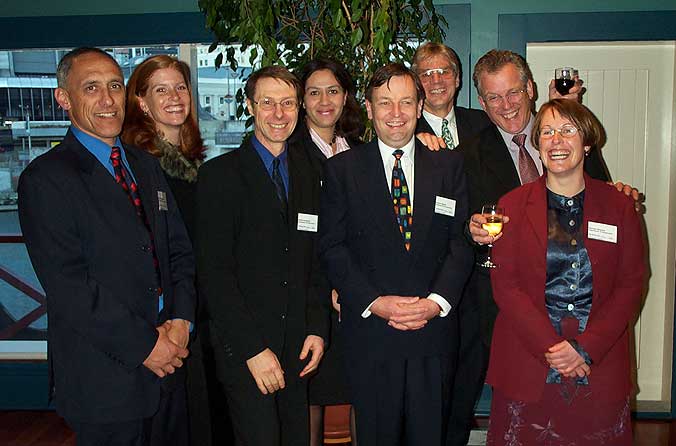
With some of my workmates at the Conservation Week DOC associates function, 2002

The friendships and quality working relationships I have with my colleagues in National Office, the Taupo Sports Fishery team and throughout DOC and also with Fish & Game Council colleagues.

What led you to your role in DOC?

I started in DOC when it was established in 1987, working with my then manager Marcus Simons on national freshwater fisheries matters. I came over to DOC from Internal Affairs/Wildlife Service (where I started my public service career in 1969). My career in the Wildlife Service was mainly focussed on trout hatchery management, so when the opportunity came in 1987 to have a role working on national freshwater fish matters in the newly formed DOC, it was an amazing thing.  

What was the highlight of your month just gone?

The Christmas period of course – family time, BBQs, relaxing, and sharing (with many colleagues) the wait finally over concerning the outcome from this current review on our individual situations. For me it will be finishing my career with DOC at the end of January and I will be leaving with many great memories.

The rule of three…

Three loves

  1. My home and family (my wife, my children and pets – two siamese cats, two turtles, tropical fish and my plants).
  2. Dry, calm, warm weather – great for growing my collection of pawpaws and bananas. 
  3. Playing my congas and bongo drums.

My hybrid pawpaws

Three pet peeves

  1. Wellington’s train problems. 
  2. Loud neighbours with barking dogs.
  3. The wind in Wellington. 

Three favourite foods

  1. Tomato and hot chilli sauce.
  2. Grilled lamb chops.
  3. Home-cooked stirfry with mushrooms, zucchinis and rice.

Three favourite places in New Zealand

  1. Little Barrier Island – incredible geology with razor volcanic ridges, native birds, kauri trees, and Boulder Beach.
  2. Wainuiomata valley (including Baring Head) – raised beaches, township, river and trout fishing, and the Rimutaka Forest Park.
  3. Takahe Valley, Murchison mountains – takahe and kea of course, and an incredible U-shaped glaciated valley with a lake and limestone cliffs and caves.

Favourite movie, album, book

  • Movie – Invitation to Hell –  1982  Directed by Wes Craven. It’s sort of Sci-fi, about a husband winning a deadly fight for the souls of his family.
  • Album – Supernatural – Santana (great conga playing).
  • Book – Gem of the Wanderer– Bob Maddux. It’s a rare, small book (fiction) and is Sci-fi with a hidden Christian theme.

    Playing the congas

Deep and meaningful…

What piece of advice would you tell your 18 year old self?

There is a lot more to karate than you think you know, and do quit smoking.

Martin doing a karate tile breaking demo

Who or what inspires you and why?

My parents instilled deep Christian values into my upbringing. I enjoy playing percussion/conga drums to contemporary Christian music at my church.

When you were a kid, what did you want to be when you grew up?

A teacher of nature study.

If you could be any New Zealand native species for a day, what would you be and why?

A forest gecko or a green gecko – in my childhood years they were mysterious critters that I spent hours searching for, and they were so well hidden.

Martin stripping a Tarawera rainbow trout in 1984

What piece of advice or message would you want to give to New Zealanders when it comes to conservation? 

Get involved in conservation – it is a very wise thing to do for the future of New Zealand.

Over the summer months, Canterbury’s Mount Grey is home to a variety of native orchids that could rival the Ellerslie flower show!

Continue Reading...

Every Friday Jobs at DOC will take you behind the scenes and into the jobs, the challenges, the highlights, and the personalities of the people who work at the Department of Conservation.

Today we profile Motueka ranger Tom Young…

At work…

Taking in the spectacular scenery in Milford Sounds

Name: Tom Young

Position: Ranger, Visitor/Historic, Motueka Area Office

What kind of things do you do in your role?

My role is pretty varied, with about 70% office and 30% field work. I am involved in a wide variety of work. I manage the Asset Management Information System (AMIS) database for the Motueka Area Office which keeps me pretty busy, and I also have several capital projects to manage each year. Back in March, we moved an old Forest Service six-bunk hut from the Right Branch Wairoa to Porters Creek in the Red Hills of Mt Richmond Forest Park—that was a challenge and great fun!

I also manage the area’s historic assets—from 1870’s gold workings in the Wangapeka, to Heritage Buildings in the centre of Nelson. I am busy with signage projects across the area and complete regular data and photo monitoring as part of the visitor monitoring (numbers and impacts) across the area. As well as all that, I enjoy getting out in the backcountry assisting the track team on track and hut maintenance projects.

What is the best part about your job?

What does it for me is the whole variety of work and the different places I get to go within the area. I get out and about a fair bit, from the very popular Abel Tasman Coast and its tens of thousands of visitors, to the relative remoteness of Mt Richmond Forest Park. It really is the variety and blend of work that does it for me. 

Crossing Big River with Steve Bagley returning from Kahurangi Point

What is the hardest part about your job?

I wouldn’t say any part was harder than the rest, it’s just different. Coordinating work, logistics and getting on with colleagues, contractors and staff is sometimes challenging. I believe the key is to manage your work and time, to be there for others and to not over-commit yourself.

What led you to your role in DOC?

I’ve been with the Department for just over eight years now. Before that, I was a Ranger in Scotland for 11 years, and some time before that I served 12 and a half years in the British Navy (much of that time in the Submarine Service). Once the Cold War was over, they gave me a medal and the Admiralty said, “Thanks, you’ve saved us from the Soviets but we don’t need you any longer”, so I decided to pursue a career as a Ranger. I went to College/Polytech for two years, and then picked up some seasonal Ranger work in central Scotland, before getting my first full time Ranger position in 1992.

HMS Torbay, my last sea posting

My family and I came to New Zealand for a month’s holiday and to stay with a friend in Nelson back in December 2000. We came back for 12 months in April 2002 while my wife completed a Commonwealth Teacher Exchange, then later in 2003 I applied for and got offered my first position with DOC at Nelson Lakes (I’m sure what swung the job for me was the fact that in Scotland I had been using an Asset Management System called CAMS, and at that time the Department’s system was called VAMS. Similar name, but quite different!). I took the job at Nelson Lakes with the idea that we might go back to Scotland after a couple of years or so, but here I am eight years later—I’m now in the Motueka Area Office—and still enjoying it.

What was the highlight of your month just gone?

I spent Christmas with my family and friends in Richmond, worked only a couple of days between Christmas and New Year and joined other friends for New Year at their bach in Kaiteriteri. I enjoyed the awesome firework display from the beach at midnight and a walk to Hardwoods’ Hole on the 1st of January. I spent four days last week cycling the 160km Central Otago Rail trail with my wife Fiona, youngest son Findlay and a couple of good friends. That was great—lots of stops on the way for coffee, refreshments, Jimmy’s pies, photographs and even a  revitalising dip in the Manuheriki River, as well as some exercise and lots of fresh air. A great time was had by all. 

Pedal pushing on the Otago Rail Trail

The rule of three…

Three loves

  1. Family, of course. I have two boys aged eighteen and eleven years. It’s great to see them grow up and develop, and support them through school and sport and whatever interests them. And of course my wife, Fiona.
  2. Coffee. Yes, I know it’s a drug. But I like it.
  3. Scotland/Caledonia/Alba/Ecosse—whatever you want to call it. It’s in my tartan blood/genes/history.

Pet peeves

  1. Some of the leucocratic nonsense we have to go through, not only in work, but also in our everyday life. Life’s complicated enough, keep it simple!   
  2. Umbrellas. They are fine if there is nobody else within four or five metres of you, but (maybe it’s because I’m tall) there’s always the danger of being skewered by one of the pointy bits or worse, getting your eye poked out. If you’re in a busy place with lots of people and want to keep the rain off, leave the brolly behind and get a good jacket with a hood!

Three things always in your fridge

Always in my fridge? Probably the usual stuff—milk, cheese, the shelves and the little light that comes on when you open the door. Oops, that’s four things!

Lunch with Visitor Asset Managers after meeting at Kahurangi Point Keepers House

Three favourite places in New Zealand

  1. Without having been everywhere it’s pretty hard to say. I do enjoy being in the mountains and above the bush line—on a fine day! I love the vastness of the country and the alpine vegetation, the snow tussock, speargrass, Spaniard, mountain buttercups and daisies and many other mountain herbs.
  2. I also love the wild West Coast beaches such as Wharariki in Golden Bay—the wind, the eroded sandstone arches, the changing sands and the relatively unspoilt wildness of it all.   
  3. I do like Nelson as an area. A great climate, a great variety of places to go—coast, mountains, plains, city etc., good mountain biking trails, great cafes and lots of friends to visit.

Favourite movie, album, book

It’s too hard to pick just one.

  • Movie: The Usual Suspects with Kevin Spacey, As Good as it Gets with Jack Nicholson and Helen Hunt, and for a side-splitting laugh, Mr Bean’s Holiday with Rowan Atkinson as Mr Bean.   
  • Book: I do enjoy a good historical conspiracy theory with a bit of drama. The Da Vinci Code by Dan Brown was pretty damn good, but again, there are so, so many contenders.
  • Album: I’d have to choose between Exile on Main Street by the Rolling Stones or Blood on the Tracks by Bob Dylan. But there are so many great albums out there.

Deep and meaningful…

What piece of advice would you tell your 18 year old self?

With Stu Houston, installing new shelter at Holyoake's Clearing, Abel Tasman Inland Track

Enjoy what you do, and do what you enjoy! Think before you speak, its easier to bite your lip than to repair damaged relationships. Respect others.

Who or what inspires you and why?

I have recently been inspired by the British particle physicist Professor Brian Cox. He is a brilliant public and science presenter/broadcaster. To me, he is starting out on the path of doing for physics what David Attenborough has done for natural history. In plain, easy to follow language he uses the media to bring an understanding of science to the masses. In addition to his programmes Wonders of the Solar System and Wonders of the Universe, and the comedy radio programme The Infinite Monkey Cage, Brian has worked on the ATLAS experiment on the Large Hadron Particle Collider in Switzerland and on modifying Newton’s law on gravity.

When you were a kid, what did you want to be when you grew up?

Mmmmm… that was a long, long time ago! I did want to travel and see the world, and I guess that in part led me to my time in the Royal Navy, where I spent most of my time deep down under the sea (how deep is a secret).

And now, if you weren’t working at DOC, what would you want to be?

I really enjoyed my Ranger job in Scotland. I would like to think that there would still be a role there for me, and that I could contribute to the conservation and countryside management back there. As a Ranger in the UK, I did a load more environmental education, public access work and management of reserves close to urban and populated areas, which I really enjoyed. I could do that again. 

If you could be any New Zealand native species for a day, what would you be and why?

With my love for the mountains (on a good day), I’d be a Chequered Alpine Snout Moth. I’d check out the alpine passes, breath in the cool mountain air, enjoy the vista and miss the wild, wet, cold and snowy winter, (because they only live from November to February). 

What piece of advice or message would you want to give to New Zealanders when it comes to conservation? 

Enjoy, appreciate and conserve what we currently have. It’s not just the fauna and flora, the landscape, the huts and tracks, the forest, the lakes and rivers and the ocean—it’s everything, including the smells and the sounds, the wind and the warmth, the time, the energy and the space. I believe many New Zealanders generally don’t really appreciate how fortunate we are and what we have in our own back yards. Too often it’s only when it’s gone that we realise what we have lost—and then it’s too late.

Every Friday Jobs at DOC will take you behind the scenes and into the jobs, the challenges, the highlights, and the personalities of the people who work at the Department of Conservation.

Today we profile Opotiki ranger James (Hemi) Barsdell…

James with a kiwi at Otamatuna - Te Urewera Mainland Island

At work…

Name: James (Hemi) Barsdell

Position: Biodiversity Assets Ranger (with a bit of other stuff too!). 

What kind of things do you do in your role?

Monitor weka, enhance shorebird breeding, work with the many dedicated community groups in the eastern Bay of Plenty, compliance work, fire fighting and whatever else needs doing.

What is the best part about your job?

The people and the environment.

What is the hardest part about your job?

Although I haven’t done this for a wee while now (as my increasing waist line can attest), lumping loads of gear throughout the hills. Oh and dealing with irate whitebaiters.

What was your highlight from the month just gone?

An acknowledgement for the ‘Volunteer Smoko’ I helped organise with the local and regional councils to thank the eastern Bay of Plenty conservation volunteers for their great efforts in the past year. The event gave each group a chance to show case what they do and to network with each other. From the feedback we received it sounds like it might become an annual event!

The rule of three…

Three loves

Hunting

  1. Family
  2. Hunting
  3. Seafood

Three pet peeves

  1. Being late
  2. Forgetting stuff
  3. “Gonnas” (if you don’t know what this means, someone else will)

Three things always in your fridge

Not very exciting here…

  1. Milk
  2. Butter
  3. The one year old half-eaten jar of pickles

Three favourite places in New Zealand

  1. Maungapohatu
  2. The South Island high country
  3. The Bay of Plenty

Maungapohatu - a special placeHunting

Favourite movie, album, book

  • Movie – The Shawshank Redemption
  • Album – The Eagles –  Hell Freezes Over
  • Book – Pack and Rifle by Phillip Holden

Deep and meaningful…

What piece of advice would you tell your 18 year old self?

Think smart and slow down. Faster is not necessarily better.

Who or what inspires you and why?

People who, against all odds, become successful or break the mould; and sunset or sunrise viewed from on top of a high hill.

Rafting the Motu river

When you were a kid, what did you want to be when you grew up?

A helicopter pilot.

And now, if you weren’t working at DOC, what would you want to be?

A surveyor.

If you could be any New Zealand native species for a day, what would you be and why?

A New Zealand falcon, so I could enjoy the rush of tearing through the air at unbelievable speeds chasing prey.

What piece of advice or message would you want to give to New Zealanders when it comes to conservation?

Get active and get involved. New Zealand’s native flora and fauna is a big part of what sets us apart from other countries—it is part of our identity. We need to ensure we maintain our heritage for the future.

Alison McDonald from Whangarei Area Office has been closely watching the fairy tern drama in her area. She fills us in on the latest goss from the beach…

Fifteen years ago I watched David Attenborough’s ‘The Private Life of Plants’ and it transformed my perception of flora, from the benign green stuff I took for granted, into a complicated and surprisingly sophisticated world of intrigue.

Fairy tern and a breeding NZ dotterel on the spit at Waipu

Though I have long been an admirer of birds, it is fair to say that my short time spent working closely with our little tara-iti (New Zealand fairy tern) has had a similar effect.

Compared to the charismatic kea or the oddities of a kiwi, our wee fairy tern might seem fairly plain to look at, but having the privilege of ‘getting to know them’ (so to speak), has placed a spotlight on the scandal, drama and mystery of their daily lives which any soap opera would struggle to compete with.

When it comes to breeding just about everything counts against tara-iti—fertility, habitat, weeds, wind, sand, tides, people, dogs, gulls, hawks and every other introduced mammal—so with ten breeding pairs or less in a population of just 40 birds, there’s a lot riding on each and every nest. Last season saw just about all of the adverse elements take their toll, and by summer’s end only five fairy tern chicks had made it to fledging. Let’s hope this season will be a better one.

A fairy tern nest at Papakanui camouflaged amongst the shells

Waipu is one of the four remaining breeding sites, and this year it started off with a single pair of terns, which I dubbed Minnie and Pilgrim, (easier than repeating ‘M-Nil and Blue, Pale Green dash Metal’). These two were joined by a hopeful young male in his first breeding year who, much like a third-wheel, hung out with the couple rather cramping Pilgrim’s style.

Vulnerable nests: king tides at Waipu

For weeks and months our third-wheel hung around but eventually, as breeding season approached, I begun to see him less and less. In early November, on a routine check of possible nest sites, who did I find but our third-wheel stuffing a very gravid female full of fish at a new nest site. A quick check of bands revealed that our little stud had managed to procure himself a female—one who had previously been seen courting another male at the Mangawhai breeding grounds. The poor, ‘shafted’ male turned up regularly at Waipu and could often be found shuffling round the tip of the spit all alone for long stretches of time.

A week later I happily reported that Minnie and Pilgrim also had a nest and that we had a third pair who had been seen copulating in the area. That third ‘pair’ turned out to be none other than our already expectant mother, Minnie, and the lonely male. Minnie seemed only too happy to take the continued offerings of food from this male and let him perform his mating ritual before she flew back to relieve Pilgrim of his incubating duties. How long she can keep up with this double life remains to be seen…

Our little stud keeping his very gravid female well fed

I’m happy to report that, despite the drama, both nests have so far made it past king tides, strong winds and, more importantly, the fertility test! If all goes well with our two hatched chicks this season, Waipu can add two more fairy terns into the population mix.

The lonely male off on another search for his missing female