


By Tōrea Scott-Fyfe
It started right at the beginning of the trip. Eight DOC workers and three Ngāi Tahu contractors squeezed around a small Airbnb table, eating nachos. We were from all sorts of backgrounds; some of us already knew each other well, others didn’t know anyone. Our group had assembled today in Invercargill for the final preparations before sailing to subantarctic Auckland Island, to work on various aspects of the Maukahuka / Auckland Island Restoration project (see my previous blog on the project). There was plenty to talk about, but it was hard to know where to start. I can’t remember who suggested it, but we all embraced the opportunity…
‘What’s your peak and pit from today?’
We went round the table, bringing up memorable moments: the drudgery of cleaning our gear for biosecurity (we don’t want to carry any new pests down with us); the elation of receiving a chocolate frog (the rare reward for having perfectly clean, seedless gear). Work towards planning and preparing for this trip started almost a year ago, so for those involved in the planning, seeing everything come together for the trip ahead was a huge, almost unbelievable peak.

A week later, the same group plus a few of the boat crew sat on the cushioned benches that line the edges of the small saloon on the SY Evohe. We had our plates perched on our knees, trying our best to tidily cut into steak without elbowing the person next to us or spilling it all on the floor. ‘Come on, peak and pit,’ someone said. It came easier now, and each peak or pit was accompanied by sympathetic hmms or mostly-friendly jibes, and lots of laughter. We had reached the island; had shared together the interminable days at sea where many of us didn’t manage to eat without throwing it all back up. We had seen whales, albatross, the never-ending swell of the open ocean. We had set foot on the island and got stuck in the scrub. We had started the work that we were here for — putting out cameras for a bait acceptance trial — and we had already seen the damage made by pigs and feral cats. We all needed a chance to vent, to express awe, to have a laugh. To make this inhuman place more human.

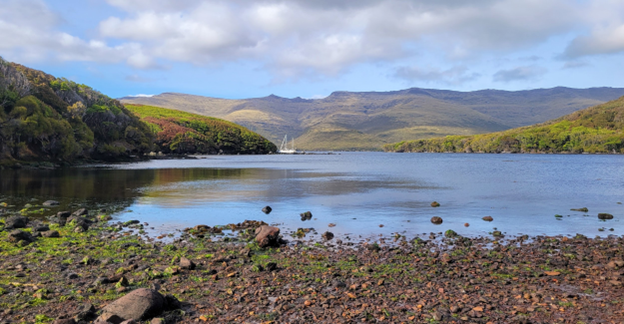
Then there were four of us, standing on the beach in Camp Cove. We were silent as we watched the Evohe lift anchor, and slowly disappear behind Anjou Point. A kākāriki fluttered into and out of the sky. A korimako chimed behind us. The sea lapped at our feet. It was very quiet, and smelled of salt, seaweed, leaf litter — no human smells but the smell of each other.

Our shelter here is a white canvas tent, like a marquee but more solid, with sturdy metal beams and a plywood floor. It is light inside, but a little industrial feeling. That first night, there was ingrained dirt on the floor and half unpacked fish bins piled precariously throughout the room. We ate stir-fried vegetables and noodles off plastic plates. We had just discovered that we only had two forks for the four of us, although plenty of spoons.
‘We’ll have to mop the floor,’ I said.
‘We’ll have to whittle some forks,’ someone else said.
Other than that, we stared into the overwhelming distance of the trip ahead of us. We were all shattered — the long boat trip and then the four days of flat-out work when we first arrived had drained us. Now that the boat was gone, we crashed.
‘Shall we keep doing peak and pit?’ Kristen asked cautiously. ‘We don’t have to.’ But we all leaped at the offer. We needed it, I think, to keep connecting. Otherwise, the strangeness of our situation overtook us. We didn’t know each other well enough yet to bring up the hard things, or the best things, without it.

It’s strange thinking back to those days at the beginning, when our whole trip stretched out, unknowable. There is definitely a lot more dirt on the floor of our marquee-tent now (despite our regular sweeping), but it doesn’t worry me anymore. It’s our dirt. It’s familiar. The food fish bins, which were piled three high in six stacks, are reduced to a total of six almost empty bins. We have our clothes hanging up to air off the metal beams. We know where to find everything when we want it. We never whittled new forks, but are competent at scooping up even spaghetti with our spoons.
The Evohe is on its way to pick us up. Today we brought in half the cameras from our grid. It’s a matter of days before we have to pack up our trusty tents, fold up the table, scrub the marquee floor one last time, and carry everything back down to the beach. All the signs of us will be gone again. This marquee-tent will stand empty, waiting to take on the character of the next group of humans to make this place home.
‘Peak and pit from today?’ We haven’t kept it up every day; we know each other well enough now to get to the important stuff in general conversation. But it’s a tradition that we enjoy. A way to measure our days.

Today, all of our peaks involve a moment in the sunshine. The sun has been a rare character over the last five weeks, but at about 11am we all felt it peeking through the clouds. Kristen talks about the feeling when you look towards the sun with your eyes closed and see the warm red light of it through your eyelids. What a good feeling that is!
My pit is dropping a piece of chocolate into the water when I was walking back around the coast. It was high tide, and I had to do a lot of wading. Today is the first time I’ve got back after dark. It gets dark two hours earlier now than when we arrived. We can feel winter creeping in.
Now, with the nostalgic feeling of endings settling around us like a heavy blanket, we start to think about peaks and pits on a bigger scale. The peaks and pits of the whole trip, of this journey that we are nearing the end of. We are looking forward to sunlight, cosy fires, seeing friends, sleeping in comfy beds. But we are going to miss the company of pakake, korimako, petrels, and toroa. We will miss walking out each day onto an island of such awe-inspiring wilderness.

We feel satisfied by how much we’ve achieved while here. We worked to learn more about the feral cats, the mice, the invertebrates, the freshwater fish, the plants, and the cliffs where the albatross are still able to nest. We have gotten to know many aspects of Maukahuka so much better, and our new knowledge and understanding will help us immensely when the eradications go ahead.
We got to know Maukahuka, and now we don’t want the rhythm of life here to change. The human world draws us away, but we all hope to come back.
As this is our final blog from the island, you can stay connected to the Maukahuka / Auckland Island Restoration project through the link below. This project’s success will help shape the future of one of the world’s most remarkable island ecosystems. But we still need your help to make it happen. To learn more about the programme—or to be part of this incredible conservation effort—follow the link below to donate.
Auckland Island / Maukahuka | NZ Nature Fund


What a great read! Thanks team.
What great writing! Thank you – a book in the making!
You forgot to mention your very last Peak you shared while on Evohe – Scrubbing the floor!
What a great descriptive read, capturing the feel of the bleak and cold island. I’m glad you got accustomed to the dirt ingrained on the ply floor! Nice change to see a move away from the pollyanna approach of relentless positivity to more realistic emotions.