Archives For 30/11/1999

Always helpful and friendly, Anna Humphries, a Department of Conservation Community Relations Ranger, knows her stuff when it comes to working with film crews in one of the most popular filming and tourist destinations in New Zealand.

This story was taken from nzhomeofmiddleearth.com

She always has her wits about her as she protects the environment, whilst allowing filmmakers the freedom to roam our beautiful wilderness.

Anna chilling out in Middle Earth

Anna chilling out in Middle Earth

Anna is one of three community relations rangers in the Wakatipu area. Each year she processes around 80 one off permits, including those for local and international film projects, helping the film makers get the footage they need without damaging the environment or impacting on the rights of other people using the area either recreationally or for business.

Recce day in the Passburn Valley – looking for good places to land.

Recce day in the Passburn Valley – looking for good places to land

She is always quick off the mark with ‘out of the box’ solutions to problems faced by crews, to help make filming go smoothly.

She is featured in a nationwide Film New Zealand advertising campaign highlighting the crucial role skilled New Zealanders working outside the screen industry played in the production of The Hobbit: An Unexpected Journey, and the success of the New Zealand screen industry in general.

The film crew of the Hobbit waits for the rain to stop

The film crew of the Hobbit waits for the rain to stop

“I know I should be flattered, but it’s a little mortifying none the less!” Anna says. But she still thinks working with film crews is fun.

“I never knew what they’d be asking me to consider next but they’re very professional. They understand our conditions and will go that extra mile to meet them,” she says.

Film New Zealand CEO Gisella Carr, says that if there was an award for ‘Best Supporting Country’ New Zealand would win hands down.

Dwarves enjoy the view

Dwarves enjoy the view

“It took more than cast, crew and producers to make The Hobbit Trilogy happen. It took a huge supporting role from everyday New Zealanders like Anna who did their jobs with enthusiasm and great skill,” Gisella said.

She says the sheer magnitude of the impact a production has on a country like New Zealand is clearly illustrated by recently released statistics. These showed that due to the filming of The Hobbit:

• 99 sets were built
• 6750 domestic flights were taken
• 19 commercial properties were leased long term
• 93,000 hotel bed nights were sold
• 1800 rental cars were hired
• 1650 work vehicles were used
• $380,000 was spent on coffee
• $9,180,000 was spent on set construction materials (with local suppliers)
• approximately 16,000 days were worked by New Zealand actors
• $1,450,000 was spent with local food suppliers

She says New Zealand is known as one of the most ‘film-friendly’ countries in the world.

The Hobbit: An Unexpected Journey is in cinemas now.

By Dave Houston

Declining nest numbers

Juvenile yellow-eyed penguins loitering on Sealers Bay beach in 2001

Waaaaay back in 1981 I encountered my first yellow-eyed penguin on Codfish Island or Whenua Hou.  20 years later I was back on Codfish with DOC colleague Dean Nelson and David Blair of the Yellow-eyed Penguin Trust (YEPT) as part of the first ever census of yellow-eyeds on Stewart Island and its outliers.  While the numbers found on Stewart Island were alarmingly low, things on Codfish looked good with 61 breeding pairs and more than 40 juvenile (1-year old) birds seen.

A ‘classic’ yellow-eyed penguin nest under a rata tree

Eight years later Dean and I went back to Codfish with Sandy King of the YEPT to see if the decline in penguin numbers on the Anglem coast of Stewart Island was mirrored there, we took the best cooler with us fulled with goodies.  A week of searching revealed only 46 pairs, down 25% on the previous count.  We also saw no juvenile birds, an indication that poor food year had reduced the survival of the young birds in their first year at sea.  To be sure that this was not just a temporary blip in a bad year, Dean and I again went to Codfish and searched for nests in 2011.  Again, no juvenile birds were seen and nest numbers had dropped further to just 39 pairs.

This year Dean is back on Codfish on his own to see if the trend is continuing.

Finding penguins

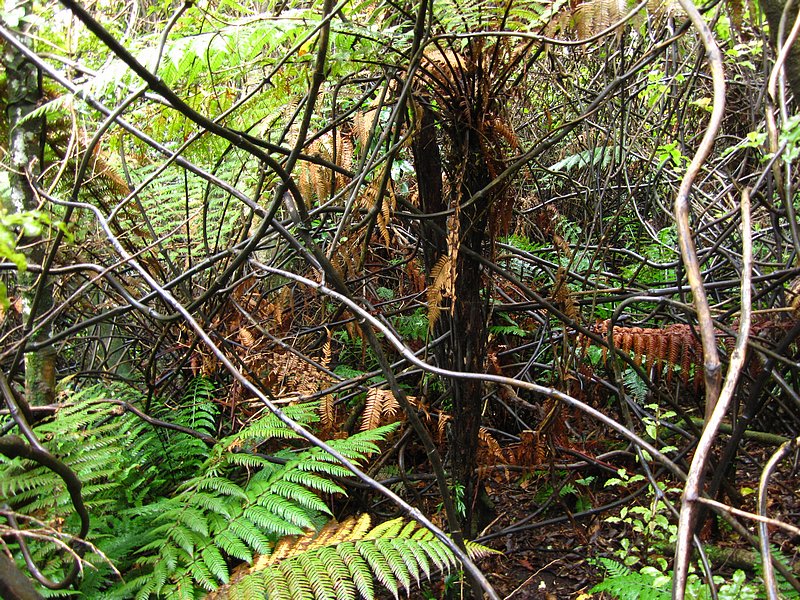
Supplejack tangle: There's a penguin in there somewhere.

Supplejack tangle: There’s a penguin in there somewhere

To the uninitiated, counting penguins seems like ‘a walk in the park’.  Instead it can be a dirty, frustrating and physically demanding task.  Yellow-eyed penguins nest in forest, ususally with their backs to a tree or in dense vegetation and up to 500m inland.  Finding them means starting at their landing point and following the often subtle signs of a penguin track, ocassionally dotted with tell-tale penguin poop.  Unlike us somewhat taller humans, penguins have no trouble negotiating the thick vegetation and seem to take delight in detouring through the thickest supplejack patches on the way to their nests, sometimes necessitating a hands and knees approach.  The smell of seabird poop can alert the searcher that a nest is nearby and then close inspection of all likely looking hollows and thickets is required.

Once found, the nest is checked for eggs, the attending bird is checked for a flipper band or transponder and the nest marked by GPS and flagging tape so that the nest can be revisited later in the season to determine breeding success.

What’s going on?

Dean checking a nesting bird for a transponder

Dean checking a nesting bird for a transponder

Yellow-eyed penguins are long-lived (Dean just found a couple of  birds he banded as chicks 20 years ago) and Codfish island is predator-free, so why isn’t it a penguin paradise?  Despite good breeding success in most years, first-year survival of penguins can be very low in years when food resources are low.  It seems that Codfish has experienced several of these poor years in recent times, meaning that few young birds have survived to enter the breeding population.

While adults are safe on their island sanctuary, at sea they are vulnerable to predators (mainly sharks) and by  enganglement with nets set for rig and elephant fish (species most often encountered in your fish-and-chip shop). The extent of this at-sea mortality is not well understood.

And in news just in…

Dean has just emerged from the bush having found 39 nests, no change on last year (read his search dairy here).  While not great news, it does confirm that last year’s low count was not a ‘one off’ low count and that something is really going on here.  The continued absence of  juvenile birds suggests ongoing unfavourable marine conditions.  Hopefully next year’s count will start to show a positive trend.

Yellow-eyed penguins at sea

Yellow-eyed penguins at sea

by Caroline Carter (and Victoria Wood)

The opportunity to be a ‘Ranger for a day’ has proven a hit with senior students from Fiordland College.

On Friday 3rd August more than 30 students teamed up with DOC rangers from Te Anau and got a glimpse of just what it takes to manage New Zealand’s largest National Park

Roving reporter, Vicky Wood, interviews classmates, Tarn Grant
and Annika Meyer, at Te Anau Wildlife Centre

‘Ranger for a day’ is part of DOC’s support of the Kids Restore the Kepler project. This major restoration project, led by the Fiordland Conservation Trust and funded by Kids Restore NZ, aims to inspire Fiordland’s young people to care for their environment now and in the future. 

Caroline Carter, the education coordinator for the project, said the idea to work-shadow a ranger came about following a realisation that every student has skills and interests that are needed to achieve conservation goals.

DOC Ranger Ken Bradley supervises Barlow Rewita as he helps to
shift 8 cubic metres of gravel using a ‘muck truck’

15 year old Victoria Wood became more aware of this than most as she got to be a ‘roving reporter’ for the day. Commenting that she might just be the luckiest of them all, Victoria got to visit her classmates in their various locations and see what they were up to. 

Here’s her story:

Rangers for a day – by Victoria Woo

Fiordland College Year 11 students were lucky enough to be the first rangers for a day. We got to work alongside DOC staff and gain an insight into what their many and varied jobs entail. 

One of the team members from DOC approached careers counsellor Mrs Humphries a few weeks earlier to ask if we wanted to work-shadow a DOC ranger for a day. We were pleased that Mrs Humphries accepted as we were eager to take part. On the day, the parent of a sick student rang up the school to notify them that their child would not be able to attend, however he was so eager to take part he turned up at the last minute! 

Daniel Carruthers adds a special pellet mix to the hoppers
in the takahe enclosure

The tasks that we experienced included fixing vehicles and machinery at the DOC workshop, gardening and feeding native birds at Te Anau Wildlife Centre, assisting with the takahe recovery programme at Burwood Bush, checking didymo cleaning stations around Lake Manapouri, servicing and re-setting traps on the Kepler track, carrying out compliance checks on the Milford Road, publishing articles for the DOC website, assisting with jobs in the Visitor Information Centre and undertaking a river survey of whio/blue duck with the help of a specially trained dog.  

Matte Servaty teams up with rangers Richard Kindsey and Lynsey Murray
to carry out didymo checks around Lake Manapouri

A group of students also got to carry out maintenance work on the track at Tui Bay using a range of machinery under close supervision. This team shifted over eight cubic metres of gravel in under three hours. That’s twice the size of an average 4WD truck, and they did all this with only a ten minute lunch break. “This dedication is outstanding” said DOC ranger Ken Bradley. 

Barlow Rewita helps to shift gravel

There is no doubt that the other teams have put in the same amount of effort. DOC ranger Catherine Brimecombe said “giving people an insight can sometimes inspire them, and sharing the experience will help this grow”. With the positive ‘can do attitude’ of Fiordland College students DOC is hoping to make ‘Ranger for a day’ a permanent fixture in the annual calendar.  

The day with the team at DOC was inspiring for us all, but it was even more significant for our four exchange students, three of them from Germany and one from Thailand. This was the perfect opportunity for them to find out what living in Fiordland is all about and just what New Zealand has to offer right outside their back door. 

We all seized the experience the DOC team gave us and would recommend this opportunity to everyone. A lot of memories were made, including 15 year old Daniel Carruthers who got sat on by hungry kakas while feeding them breakfast. 

Some students were caught in action by our photographer Julia, and you can see these pictures on the Kids Restore the Kepler website.  

Julia Cruz sets about making a photographic slideshow of the day

“We were all thinking that we’d be turned into greenies,” said Julia Cruz. “However, DOC has showed us what it takes to have a job like this, and that it’s based on working as a team, building ideas together and getting the community in on it too.  It’s a really positive work place that we can all contribute to,” she added.

Come behind the scenes and into the jobs, the challenges, the highlights, and the personalities of the people who work at the Department of Conservation (DOC).

Today we profile Programme Manager – Visitor Information, Christine Officer.

At work…

What kind of things do you do in your role?    

I’m responsible for managing the Fiordland National Park Visitor Centre and, in collaboration with others, I oversee the sales and marketing of the three Southern Great Walks, i.e. the Milford, Routeburn and Kepler tracks.

I’m also the DOC link in our local and regional tourism industry—and as part of this, have a role as a board member for Destination Fiordland (the Regional Tourism Organisation). 

Day at the office for a hut ranger – overlooking Lake McKellar, Greenstone Valley

What is the best part about your job?

Well I never wake up thinking “I wish I didn’t have to go to work today!” (that was always an aim for me when looking for a job)… plus I have an awesome view from my office!

Lake Manapouri – view from the end of our street!

What is the hardest part about your job?

I gotta admit that it’s hard to sit in a chair at a computer in an office all day (even if its a nice view), after working outdoors for a good 10+ years. But the people I work with make it fun and worthwhile.

What led you to your role in DOC?

Often a long story… but the turning point for me was living and working for Alpine Guides in Aoraki/Mt Cook during my university holidays, and suddenly realising that it was possible to have a career doing what you love, in a place you love—the outdoors!

Hiking in the French Alps last year

What was your highlight from the month just gone?

It’s over a month ago now, but taking the Air NZ sponsorship team out onto the Milford and Routeburn tracks was a pretty fun and rewarding experience. Dropping the team off by helicopter on a piece of rock, on top of Sutherland Falls (580m) for 20 minutes to soak in the scale of Fiordland and the Great Walk experience made me feel very proud!

The rule of three…

Three loves

  1. A hot cuppa tea in a hut after walking in the rain all day
  2. A good New Zealand roadie – freedom at its best
  3. Wearing shorts and runners to work in summer

Loving the outdoors! Awesome DOC girls’ trip – Cascade Saddle, Matukituki Valley

Three pet peeves

  1. Running out of Dilmah
  2. Running out of milk to put in my Dilmah tea
  3. Having to put milk powder in a cup of Bell tea

Three foods

  1. Japanese food
  2. Japanese food
  3. Japanese food

Three favourite places in New Zealand

  1. Fish ‘n’ Chip caravan at Jackson Bay (got taken there by my husband on our first ‘date’ – round trip 586km!)
  2. Lake Manapouri – totally beautiful in any kind of weather
  3. Red Tarns, Aoraki/Mt Cook – a very special place to live

Favourite movie, album, book

  1. Movie: Lost in Translation
  2. Album: Stuck on this one – (makes me realise I need to get my ipod off shuffle)!
  3. Book: The Poisonwood Bible by Barbara Kingsolver

Deep and meaningful…

What piece of advice would you tell your 18 year old self?

Do what you love and what excites you! A formula for happiness.

Best way to get to work – beach landing on Codfish Island

Who or what inspires you and why?

Travel in third world countries always inspires me—seeing happiness, richness and colour in simple basic lives.

When you were a kid, what did you want to be when you grew up?

I always thought having a job on “The Love Boat” seemed like a good idea! The ‘love’ bit escaped me at 10 years old, but the travel and pool looked like fun!

And now, if you weren’t working at DOC, what would you want to be?

Rich enough to not have to work. So I’d probably end up living the same life and still doing stuff for DOC – just doing it for free, and not being as reliant on payday!

What sustainability tip would you like to pass on?

If you live within half an hour of work, just walk—its good for your mind and body.

Kea

Which green behaviour would you like to adopt this year—at home? At work ?

A few bike rides to/from work in summer (20 kilometre) wouldn’t go amiss.

If you could be any New Zealand native species for a day, what would you be and why?

A kea—it looks like so much fun! Imagine being that cheeky and being able to get away with it.

What piece of advice or message would you want to give to New Zealanders when it comes to conservation?

It all starts with awareness and appreciation, so get out there camping in the backyard with the kids. They’ll love you for it.

By Paul Jacques

2011-12 has been another successful season of rat trapping in Mason Bay, Stewart Island/Rakiura. Rat capture dropped steadily from 165 in August down to just 8 in December, providing a welcome break from rat predation for breeding birds such as red-crowned kakariki (pictured), bellbird, brown creeper and Stewart Island robin. By the end of the season the rat tracking rate was 0% within the trapped area compared to 30% in un-trapped forest nearby, good evidence that the 331 kills this season have again reduced the rat population significantly.

Red-crowned kakariki

NZDA trappers re-baiting a trap at Mason Bay

Between August and December each year five teams of keen NZDA volunteers head to the Bay to check, re-bait and maintain the network of over 300 traps. DOC helps out with travel costs and also provides technical assistance such as running tracking tunnels to measure rat abundance at the start and end of each season.The Mason Bay rat trap network is a co-operative project between the Southland Branch of the New Zealand Deerstalkers Association and DOC Stewart Island Field Centre. The traps are run during the bird breeding season with the aim of increasing the productivity of native birds by reducing rat numbers at this crucial time of the year.

The traps protect about 200 ha of coastal podocarp/broadleaf forest situated between the nationally important Mason Bay sand dunes and the freshwater swamp. While controlling rats in this spectacular environment the volunteers have the opportunity to hunt both red and white-tailed deer and also have an excellent chance of spotting a kiwi.

Looking South across the trapped area from the Big Sand Pass

This season’s trapping will begin again in August. This year we plan to trial a bird monitoring method used by other community groups around New Zealand, to measure changes in bird numbers over time in response to trapping. We will also be looking into options for feral cat control to run alongside the rat network.

For more information about the project please contact the Southland NZDA or DOC Stewart Island Field Centre.