Archives For 30/11/1999

By Cheryl Pullar, Partnerships Ranger based in Owaka

What do you do when a native bird just won’t learn to help himself? For one yellow-eyed penguin, it was time for the tough love approach.

This year we witnessed a disastrous breeding season for yellow-eyed penguins on the mainland. Every year in November and December, chicks begin to hatch around the wild beaches of the Catlins, Otago Peninsula and North Otago.

Yellow-eyed penguin wandering to the surf.

Juvenile yellow-eyed penguins are well-known for their wandering ways

There are often a few chicks that are abandoned by their parents or aren’t well fed, and need to be removed from their nests for supplementary feeding. But this year, a late breeding season and lack of fish to eat has meant a large number of chicks have gone hungry, and many have died.

To help protect the population of what is thought to be one of the world’s rarest penguin species, we remove underweight chicks from the nest before fledging and take them to rehabilitation centres like Penguin Place on the Otago Peninsula.

Looking at penguin chicks at Penguin Place.

Penguin Place’s Lisa King and DOC’s Andrea Crawford check on chicks at Penguin Place

So earlier in the year, 63 chicks were removed from the Catlins and taken to Penguin Place. This included chick J19013 (a lively young male, according to his measurements), who was taken on 10 February from Penguin Bay, weighing only 3.8 kg.

J19013 was first released from Penguin Place on 20 March at a fine 5.2 kg, but returned to the release location in early April, again underweight. So he was taken back to rehab, fattened up, and released again 14 April. However, the same thing happened again; he returned to the release site a few days later underweight, and was fattened in rehab again. All in all J19013 was released six times!

After talking with J19013’s caretakers, we decided to take a ‘tough-love’ approach—by bringing this bird back to the Catlins, a 1.5 hour journey by road, for a hard release at Jacks Bay, close to where he hatched. The area was monitored over several days to ensure that this charismatic young bird took to the sea.

J19013 took off like a rocket when we let him out of the cage, and disappeared quickly into the surf. Now he’s either got a heck of a long swim back to Penguin Place, or he will have to learn how to catch his own dinner.

Come behind the scenes and into the jobs, the challenges, the highlights, and the personalities of the people who work at the Department of Conservation (DOC).

Today we profile Hannah Edmonds, Biodiversity Ranger in the Fiordland District Office.

At work

Some things I do in my job include…monitoring Haast tokoeka (kiwi) chicks on crèche islands, little spotted kiwi, mohua and saddleback translocations, monitoring Fiordland crested penguins, monitoring long and short tailed bats, and monitoring lizards on islands and in the alpine.

Releasing Haast tokoeka on Pomona Island. Photograph: Barry Harcourt

Releasing Haast tokoeka on Pomona Island with Blair Hoult

This helps achieve DOC’s vision by…ensuring the survival of wildlife and restoring ecosystems.

The best bit about my job is… visiting some amazing places, and working with challenging and endearing species.

The awesome-est DOC moment I’ve had so far is… oh so many awesome moments, it’s hard to choose one but flying over Fiordland in the fading light after dropping of little spotted kiwi to their new home on Chalky Island (who’ve been absent from Fiordland for 100 years) would have to be up there.

The DOC (or previous DOC) employee that inspires or enthuses me most is…no one particular person. There are many of my colleagues that work above and beyond a normal working week, driven purely by passion.

Hannah climbing in the Sinbad Gully searching for Sinbad skinks.

Climbing in the Sinbad Gully searching for Sinbad skinks

On a personal note…

Most people don’t know that I… hmmm, now why would I share a secret?

The song that always cheers me up is… “Sun is shining” by Bob Marley… guaranteed to make you smile and not get it out of your head, even if it is raining!

My stomping ground is… Fiordland’s wild places.

If I could trade places with any other person for a week—famous or not famous, living or dead, real or fictional—it would be… David Attenborough.

My best ever holiday was… probably trekking in India and Nepal.

If I could be any New Zealand native species I’d be… a short-tailed bat – imagine being one of New Zealand’s only native land mammals, being able to fly at night and having plenty of attitude!

My secret indulgence is… Trademe!

If I wasn’t working at DOC, I’d like to…travel the world, be famous, own an island… not too much really!

Before working at DOC I… travelled the world, but never owned an island.

A Fiordland crested penguin with chick.

Fiordland crested penguin with chick on Breaksea Island a few weeks ago

On a kiwi note…

What would a New Zealand full of kiwi look like? Like a brown mass of fluffy feathers!

If you could give kiwi one super power, what would it be? Super size it so it becomes like a moa.

How can everyday New Zealanders help save the kiwi? Take part in predator control, do volunteer work with kiwi, or make donations to kiwi charities.

If you could ask a kiwi one question, what would it be? What does the world look like to you?

Do you have a favourite kiwi? Fiordland tokoeka of course!

A helicopter being loaded with mountains in the background.

Loading helicopter with boxes of mohua in the Landsborough, to be released on Resolution Island

Deep and meaningful…

My favourite quote is… “I like nonsense, it wakes up the brain cells. Fantasy is a necessary ingredient in living, it’s a way of looking at life through the wrong end of a telescope. Which is what I do, and that enables you to laugh at life’s realities,” by Dr Suess.

The best piece of advice I’ve ever been given is… go with the flow.

In work and life I am motivated by… doing something I enjoy, and making a difference.

Come behind the scenes and into the jobs, the challenges, the highlights, and the personalities of the people who work at the Department of Conservation (DOC).

Today we profile Taranaki based biodiversity ranger, Kelly Eaton

Kelly with her brother Fraser graduating as a Navy Officer.

My dad, brother (graduating as a Navy officer) and me!

At work…

What kind of things do you do in your role?

Well I do a range of field work and office tasks. I am mainly in the field doing things such as maintaining and checking the stoat trap network on Mt Taranaki; whio and Dactylanthus taylorii surveys; coastal herb field weeding to improve the habitat for rare plant species and the endangered Notoreas ‘Taranaki’ moth; along with a range of other threatened flora and fauna work—while also attempting to get volunteers involved to help me get these jobs done.

What is the best part about your job?

Seeing positive results and finding what I’m looking for, such as a whio and Dactylanthus.

A whio sitting on a rock.

One of our whio, looking handsome

What is the hardest part about your job? 

The struggle to get everything done; I want to do everything I can but there just isn’t enough time to do it all.

What led you to your role in DOC? 

Ever since I could carry a pack my father has been dragging me into the bush, taking my brother and I hunting in various spots throughout New Zealand. So somehow, although I was rather against going bush as a kid, I managed to grow up with a passion for our native wildlife.

Originally my goal was to become a zookeeper, which inspired me to obtain a degree in Zoology and a Certificate in Captive Wild Animals. After, I started to look for opportunities to gain that valuable experience. Along the way I met the right people who gave me that essential foot in the door. I gained a temporary job with the Historic Team in our National Office, which was followed by a year carrying out forest surveys with various organisations from Northland to Stewart Island, which finally lead me to my present dream job in Taranaki. Yay!

What was your highlight from the month just gone?

Getting into the rivers and tracking down whio to add to this season’s tally, and finding my first ducklings (totally cute!).

Kelly at Living Legends planting day.

2011 Living Legends planting day

The rule of three…

Three loves:

  1. Sleep—it’s amazing.
  2. Food; those who know me will know that it is a rare moment to not find me snacking on something.
  3. Massages, especially after a massive field day.

Three pet peeves:

  1. Waiting in line. If there is a big line I am just going to go somewhere else, life is too short.
  2. Disorder.
  3. Trying to find something trendy to wear when I don’t have to wear a uniform.

Three foods:

  1. Pizza.
  2. Chocolate.
  3. Meat and three veg.

Three favourite places in New Zealand:

  1. Tongariro National Park.
  2. Mt Taranaki is fairly up there.
  3. Anywhere with sunshine, golden sands and a bottle of wine.

Favourite movie, album, book:

Movies: Kill Bill 1 and 2, and anything Peter Jackson does.

Album:   Nothing comes to mind, I like a range of things. For Today by Headband may be my favourite song. Just don’t give me any of that angry screaming rubbish.

Book: Edmonds Cookery Book… well it’s the one I use the most.

Kelly feeding a giraffe at Wellington Zoo.

Feeding a magnificent giraffe at Wellington Zoo

Deep and meaningful…

What piece of advice would you tell your 18 year old self?

‘Go out there and volunteer, gain experience and make connections. It will make obtaining the job you want a bit easier’. I pass this onto many of the potential future rangers I meet.

Who or what inspires you and why?

Steve Irwin was fairly cool—that bubbly positive personality, out there, doing what he could with a passion. He taught so many people about conservation values. And Captain Planet… he’s a hero…. Are you singing the theme song in your head now?

When you were a kid, what did you want to be when you grew up?

Very briefly I thought I would be an artist, but after a few school trips to the zoo, becoming a zookeeper became my focus. I knew I wanted to work with animals.

And now, if you weren’t working at DOC, what would you want to be?

A house wife/gardener/popping out a few kiddies or saving endangered wildlife in Africa… oh the options!

What sustainability tip would you like to pass on?

Compost your biodegradable kitchen waste; it’s amazing how well the garden will grow with a bit of homemade compost.

Kelly Eaton feeding penguins rescued after the Rena oil spill.

A team of us got to help out with the Rena disaster. I was crop feeding oiled birds for a week, exhausting but rewarding

Which green behaviour would you like to adopt this year—at home? At work?

At home: car pool and ride my bike more. At work: hassle people about the ‘Check Clean Dry’ message more.

If you could be any New Zealand native species for a day, what would you be and why?

I think a New Zealand fur seal would be quite cool, flying through the water and discovering a whole new world.

What piece of advice or message would you want to give to New Zealanders when it comes to conservation?

Bored? Looking for something new to do? Interested in conservation? Your local DOC office could probably use your assistance with a project or two. Give them a call and let’s get some work done!

Kelly after climbing to the top of the Mountain.

I had to do it at least once, I made it to the top and my certificate proves it

By Dave Houston

Declining nest numbers

Juvenile yellow-eyed penguins loitering on Sealers Bay beach in 2001

Waaaaay back in 1981 I encountered my first yellow-eyed penguin on Codfish Island or Whenua Hou.  20 years later I was back on Codfish with DOC colleague Dean Nelson and David Blair of the Yellow-eyed Penguin Trust (YEPT) as part of the first ever census of yellow-eyeds on Stewart Island and its outliers.  While the numbers found on Stewart Island were alarmingly low, things on Codfish looked good with 61 breeding pairs and more than 40 juvenile (1-year old) birds seen.

A ‘classic’ yellow-eyed penguin nest under a rata tree

Eight years later Dean and I went back to Codfish with Sandy King of the YEPT to see if the decline in penguin numbers on the Anglem coast of Stewart Island was mirrored there, we took the best cooler with us fulled with goodies.  A week of searching revealed only 46 pairs, down 25% on the previous count.  We also saw no juvenile birds, an indication that poor food year had reduced the survival of the young birds in their first year at sea.  To be sure that this was not just a temporary blip in a bad year, Dean and I again went to Codfish and searched for nests in 2011.  Again, no juvenile birds were seen and nest numbers had dropped further to just 39 pairs.

This year Dean is back on Codfish on his own to see if the trend is continuing.

Finding penguins

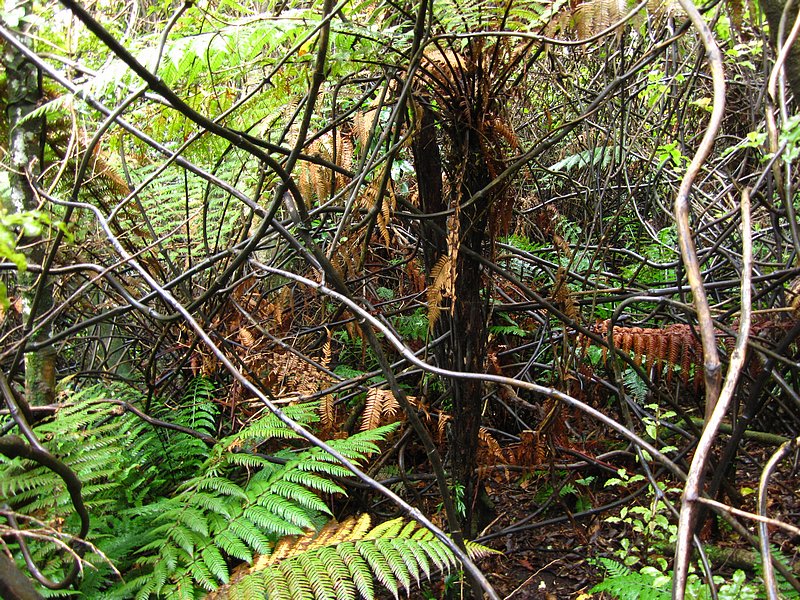
Supplejack tangle: There's a penguin in there somewhere.

Supplejack tangle: There’s a penguin in there somewhere

To the uninitiated, counting penguins seems like ‘a walk in the park’.  Instead it can be a dirty, frustrating and physically demanding task.  Yellow-eyed penguins nest in forest, ususally with their backs to a tree or in dense vegetation and up to 500m inland.  Finding them means starting at their landing point and following the often subtle signs of a penguin track, ocassionally dotted with tell-tale penguin poop.  Unlike us somewhat taller humans, penguins have no trouble negotiating the thick vegetation and seem to take delight in detouring through the thickest supplejack patches on the way to their nests, sometimes necessitating a hands and knees approach.  The smell of seabird poop can alert the searcher that a nest is nearby and then close inspection of all likely looking hollows and thickets is required.

Once found, the nest is checked for eggs, the attending bird is checked for a flipper band or transponder and the nest marked by GPS and flagging tape so that the nest can be revisited later in the season to determine breeding success.

What’s going on?

Dean checking a nesting bird for a transponder

Dean checking a nesting bird for a transponder

Yellow-eyed penguins are long-lived (Dean just found a couple of  birds he banded as chicks 20 years ago) and Codfish island is predator-free, so why isn’t it a penguin paradise?  Despite good breeding success in most years, first-year survival of penguins can be very low in years when food resources are low.  It seems that Codfish has experienced several of these poor years in recent times, meaning that few young birds have survived to enter the breeding population.

While adults are safe on their island sanctuary, at sea they are vulnerable to predators (mainly sharks) and by  enganglement with nets set for rig and elephant fish (species most often encountered in your fish-and-chip shop). The extent of this at-sea mortality is not well understood.

And in news just in…

Dean has just emerged from the bush having found 39 nests, no change on last year (read his search dairy here).  While not great news, it does confirm that last year’s low count was not a ‘one off’ low count and that something is really going on here.  The continued absence of  juvenile birds suggests ongoing unfavourable marine conditions.  Hopefully next year’s count will start to show a positive trend.

Yellow-eyed penguins at sea

Yellow-eyed penguins at sea