Every Friday Jobs at DOC will take you behind the scenes and into the jobs, the challenges, the highlights, and the personalities of the people who work at the Department of Conservation.

Today we profile Gabriela Gomez Fell.

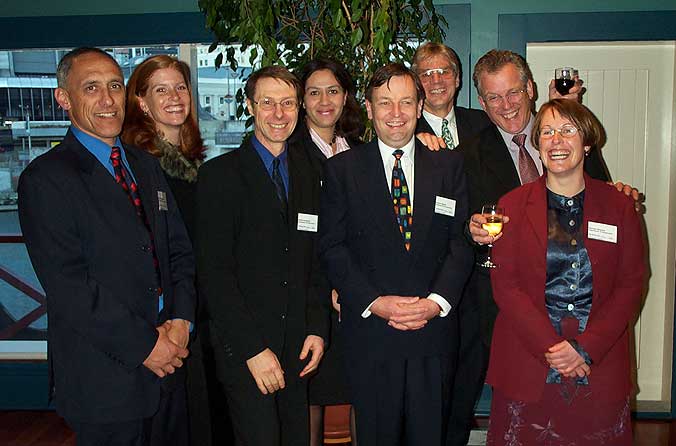
With John Adams, ex DOC and Wildlife Service legend, at our end of the year volunteer BBQ

At work…

Position: Community Relations Ranger – Hawke’s Bay.

What kind of things do you do in your role?

I organise and run events, manage volunteers, give talks, participate in our education programmes, produce our newsletter, work with the media, do a bit of web management, mmm… what else… coordinate the odd poster and pamphlet, work with the council, groups and other agencies on different projects; basically anything that has to do with the public and getting them informed/involved. Also, I occasionally get to go out in the field and I am part of a very successful catering service run by the Community Relations team = )

Playing a food web game with school children

What is the best part about your job?

Getting to see people’s faces when they learn something they didn’t know about, and working with people that like to get up in the morning to go to work.

Walk and talk to the Cape Sanctuary - waiting in line to feed Cooks Petrels

What led you to your role in DOC?

Since I arrived in New Zealand I’ve explored different areas of public conservation land, and thought DOC did a pretty good job looking after it. I was curious to see how they did it and wanted to be a part of it.

What was the highlight of your month just gone?

I got to interview students that participated in one of our education programmes years ago to see if the programme was working and if they remembered anything; they did. They remembered so much more than what I was expecting. It was a wonderful feeling to know that what we do actually does make a difference and that the messages we are putting across are being remembered.  

With Bryan Welch measuring a stranded whale

The rule of three…

Three loves

  1. My family (my husband and my family back in my home land and around the globe)
  2. Mountains (particularly in winter)
  3. Spending time outdoors (walking, taking photos, cross country skiing, cycling, kayaking, hiking and swimming)

    With most of my family on our wedding day just over a year ago

Three pet peeves

  1. Disrespectful people
  2. Ants in my pantry

Three foods

  1. Freshly picked summer fruit
  2. A good salad with fresh herbs
  3. Grandma’s baking

    Valle Frances, one of the most beautiful places from home


Three favourite places in New Zealand

  1. Fiordland (so peaceful, beautiful and similar to home)
  2. Wanaka (great atmosphere, close to Snowfarm, wonderful lake and mountains to play in)
  3. The Coromandel (particularly when the pohutakawa trees are in full bloom)

Favourite movie, album, book

Movie(s) – The Banff film fest; the movies blow me away every year, if you have not gone to one you must. And for a more mellow experience, Amelie—love it!

Album – Anything from St. Germain, you can’t go wrong with him. It is great background music for anything.

BookIn a sunburned country by Bill Bryson, I have never laughed so much reading a book.

Zapatito de la virgen - Calceolaria Uniflora, a very special flower found in Patagonia

Deep and meaningful…

What piece of advice would you tell your 18 year old self?

Don’t worry, enjoy it.

With the contorta crew - Kaweka Forest Park

Who or what inspires you and why?

Explorers, mountaineers, pioneers, people that go great lengths to follow their dreams and conquer what others might see as impossible, and people that survive challenges that would defeat others.

When you were a kid, what did you want to be when you grew up?

An archaeologist.

And now, if you weren’t working at DOC, what would you want to be?

I would probably be at uni getting a masters degree.

If you could be any New Zealand native species for a day, what would you be and why?

Some marine mammal—probably a dolphin—to be able to live underwater, play with gravity, see birds diving for food, schools of fish and penguins zooming by, and to teach other dolphins a thing or two about how great marine protected areas are and to keep away from fishing nets.

What piece of advice or message would you want to give to New Zealanders when it comes to conservation?

Go out, explore, live it, love it, be proud, get involved and let others know about it; “UNLESS someone like you cares a whole lot, nothing is going to get better. It’s not.” – Dr. Seuss, The Lorax.

Every Friday Jobs at DOC will take you behind the scenes and into the jobs, the challenges, the highlights, and the personalities of the people who work at the Department of Conservation.

Today we profile Ranger Cadet, Kevin Carter.

At work

Position: Ranger Cadet

Mount Fox makes for a great, nearby day walk with spectacular views

What kind of things do you do in your role?

A little bit of everything. As part of the cadetship programme I spent the first year working across all delivery programmes. There is a fantastic variety—from track maintenance through to weed control, from health and safety audits to being on the front desk, to name but a few. I’m really looking forward to working on the Haast Tokoeka team and starting my Community Relations placement!

My first time holding a kiwi - a great spotted female called Marama near Arthur’s Pass

What is the best part about your job?

Living down in the beautiful and isolated South Westland. This is a truly special part of the country. I love the vast tracks of lowland forests, the gorgeous mountains and the fantastic array of native wildlife. I love having the opportunity to contribute as much as I can and I’ve been lucky enough to have been offered many chances to do just that.

South Westland is one of the best spots in the country

What is the hardest part about your job?

Starting from scratch every time I join a new programme. There’s a new learning curve each time and you only have a few months (sometimes a few weeks) in each to take in as much as you can. It’s a great challenge though and it means unparalleled job variety!

What was the highlight of your month just gone?

A two and a half hour whitebait compliance helicopter flight along the coast line from Fox Glacier down to the Cascade river mouth. The coastal views of bluffs, isolated beaches, rock stacks and forested hills were simply spectacular. You get an amazing perspective of the landscape.

The rule of three…

Three loves

  1. Indian food
  2. Backcountry tramping
  3. Star gazing

Tramping in the Cobb Valley

Three pet peeves

  1. The maximum exposure time on my camera being only eight seconds
  2. People saying “your” when they mean “you’re”
  3. Facebook and Twitter logos all over the show 

Three things always in your fridge 

  1. Sour cream (gorgeous with a bag of corn chips)
  2. Dijonnaise mustard
  3. Worchestershire black sauce (best condiment out)

Three favourite places in New Zealand

  1. South Westland of course
  2. Arthur’s Pass area
  3. Cobb Valley, Kahurangi

Favourite movie, album, book

  1. Movie: Rob Roy—fantastic acting and a good story
  2. Album: At the moment: Gary Moore’s Back on the streets
  3. Book: River God by Wilbur Smith

Deep and meaningful…

What piece of advice would you tell your 18 year old self?

Don’t be so shy, get out there and make the most of it.

My surprise 21st birthday trip to the West Coast. I passed through two of the top three spots in the country

Who or what inspires you and why?

People who dedicate all their time and effort to a cause they believe in so passionately.

When you were a kid, what did you want to be when you grew up?

I went through many stages, beginning with a postman and including ‘Farmer Brown’ (I didn’t really consider the surname an issue). As I got older I thought about being an architect, an astronomer and even considered working in I.T.

And now, if you weren’t working at DOC, what would you want to be?

This is tough since working at DOC has been a long-time ambition! It would have to be an outdoors role, perhaps guiding or something in adventure tourism. Working as an astronomer would be amazing as well.

I spent many weekends trying to see as much of the North Island as I could during my summer work placement

If you could be any New Zealand native species for a day, what would you be and why?

A kea—with an impressive intellect and the ability to range from the alpine to the lowlands there’d be a stack of fun to be had. I could also join one of the ‘hoon groups‘ that maraud some towns.

What piece of advice or message would you want to give to New Zealanders when it comes to conservation?

That conservation is the most important work we can undertake. Healthy ecosystems are the foundation of our economy, recreation, identity and lifestyle. We rely on our natural environment and we need to be protecting it to the best of our ability. Our species and ecosystems are all interconnected and looking at the big picture of conservation is critical.

 
Anyone who has done the Tongariro Alpine Crossing can relate to marvelling at the sheer beauty and scale of the landscape—wondering why the Red Crater is red, the Emerald Lakes are just so and whether the hot ground under your feet is likely to erupt.

So, to answer these, and many other questions, DOC has partnered with a Turangi-based community group, Project Tongariro, to create the Pocket Ranger—a free smartphone application set to transform the way visitors to Tongariro National Park get their information. 

The Pocket Ranger provides mapping, interpretation, and safety messages for the Tongariro Alpine Crossing, as well as providing information about the local area, including accommodation, activities, transport, guiding and dining.

Taupo nui-a-Tia Area manager Dave Lumley telling tales about the crossing high above the Emerald Lakes

It has been developed so that it can be used as a ‘template’ that can be easily adapted for use in other great walks, national parks, cycle ways and mountain biking tracks. This means other organisations can take advantage of the research and financial investment that DOC and Project Tongariro have made, including licensing the technology, and won’t have to build an app. from scratch.

QR code for the Pocket Ranger

The latest version of the app. has video clips for each section of the Tongariro Alpine Crossing and includes a Quick Response (QR) code reader. QR Codes will be placed on existing track markers, at points of interest along the way (e.g. the Red Crater) and, when scanned, the QR Code will lead users directly to the information or story relating to that point of interest.

Further development is being investigated in terms of GPS capabilities, more detailed mapping, and the ability to perform a ‘check in’ at the start of the track for safety.

Capturing the stunning landscape of the Tongariro Alpine Crossing

Check it out at www.tongariro.org.nz/pocketranger and let us know what you think!

Every Friday Jobs at DOC will take you behind the scenes and into the jobs, the challenges, the highlights, and the personalities of the people who work at the Department of Conservation.

Today we profile Senior Statutory Bodies Officer Martin Gembitsky.

My wife Janine, me, and our just born grandson, Hunter

At work…

Name: Martin Gembitsky

Position: Senior Statutory Bodies Officer (Fish & Game), Policy Group, National Office.

What kind of things do you do in your role? 

I have been involved in managing the Department’s national relationship with the New Zealand Fish & Game Council since 1990. I also represent the Director-General at the New Zealand Fish & Game Council bi-monthly meetings and I liaise with CEOs and staff of the 12 regional Fish & Game Councils. There are lots of briefings and Fish & Game ministerials that I am involved with.

In my role I focus on statutory, policy, technical and relationship matters with Fish & Game, helping the national relationship with DOC to run smoothly and with the Minister and Director-General. 

In addition to my Fish & Game work, I have been responsible for organising and servicing bi-monthly NGO/DOC National Office forum meetings since 2003 . And finally,  for the last two years I have serviced the Minister of Conservation’s Loder Cup Committee and have arranged for the annual winner of the Loder Cup to be presented with it by the Minister.  

What is the best part about your job?

With some of my workmates at the Conservation Week DOC associates function, 2002

The friendships and quality working relationships I have with my colleagues in National Office, the Taupo Sports Fishery team and throughout DOC and also with Fish & Game Council colleagues.

What led you to your role in DOC?

I started in DOC when it was established in 1987, working with my then manager Marcus Simons on national freshwater fisheries matters. I came over to DOC from Internal Affairs/Wildlife Service (where I started my public service career in 1969). My career in the Wildlife Service was mainly focussed on trout hatchery management, so when the opportunity came in 1987 to have a role working on national freshwater fish matters in the newly formed DOC, it was an amazing thing.  

What was the highlight of your month just gone?

The Christmas period of course – family time, BBQs, relaxing, and sharing (with many colleagues) the wait finally over concerning the outcome from this current review on our individual situations. For me it will be finishing my career with DOC at the end of January and I will be leaving with many great memories.

The rule of three…

Three loves

  1. My home and family (my wife, my children and pets – two siamese cats, two turtles, tropical fish and my plants).
  2. Dry, calm, warm weather – great for growing my collection of pawpaws and bananas. 
  3. Playing my congas and bongo drums.

My hybrid pawpaws

Three pet peeves

  1. Wellington’s train problems. 
  2. Loud neighbours with barking dogs.
  3. The wind in Wellington. 

Three favourite foods

  1. Tomato and hot chilli sauce.
  2. Grilled lamb chops.
  3. Home-cooked stirfry with mushrooms, zucchinis and rice.

Three favourite places in New Zealand

  1. Little Barrier Island – incredible geology with razor volcanic ridges, native birds, kauri trees, and Boulder Beach.
  2. Wainuiomata valley (including Baring Head) – raised beaches, township, river and trout fishing, and the Rimutaka Forest Park.
  3. Takahe Valley, Murchison mountains – takahe and kea of course, and an incredible U-shaped glaciated valley with a lake and limestone cliffs and caves.

Favourite movie, album, book

  • Movie – Invitation to Hell –  1982  Directed by Wes Craven. It’s sort of Sci-fi, about a husband winning a deadly fight for the souls of his family.
  • Album – Supernatural – Santana (great conga playing).
  • Book – Gem of the Wanderer– Bob Maddux. It’s a rare, small book (fiction) and is Sci-fi with a hidden Christian theme.

    Playing the congas

Deep and meaningful…

What piece of advice would you tell your 18 year old self?

There is a lot more to karate than you think you know, and do quit smoking.

Martin doing a karate tile breaking demo

Who or what inspires you and why?

My parents instilled deep Christian values into my upbringing. I enjoy playing percussion/conga drums to contemporary Christian music at my church.

When you were a kid, what did you want to be when you grew up?

A teacher of nature study.

If you could be any New Zealand native species for a day, what would you be and why?

A forest gecko or a green gecko – in my childhood years they were mysterious critters that I spent hours searching for, and they were so well hidden.

Martin stripping a Tarawera rainbow trout in 1984

What piece of advice or message would you want to give to New Zealanders when it comes to conservation? 

Get involved in conservation – it is a very wise thing to do for the future of New Zealand.

By Lucy Hardy, DOC Ranger, Coastal Otago

Last week sea lion mum Gem decided to have her first pup on Tomahawk Beach, a busy Dunedin beach popular with dog walkers.

Female sea lions are sandy coloured and can be difficult to see on the beach, so DOC erected a fence around the pair to stop unsuspecting dog walkers getting a surprise.

Keen volunteers from the local Tomahawk Smails Beach Care Trust, the New Zealand Sea Lion Trust, the Yellow-eyed Penguin Trust and DOC, kept an eye on Gem and the pup, providing visitors with information about the New Zealand sea lion and advice on keeping dogs under control.

Staff knew that Gem would get hungry and head out to sea leaving her young pup alone and vulnerable. The unanimous decision was made to move the pair to a safer, quieter location.

The transfer team assembled early in the morning at Tomahawk Beach on Friday 20 January. DOC staff from Coastal Otago, Otago University researchers, Nathan McNally and Amélie Augé, New Zealand Sea Lion Trust members, Stevi Broni and Shaun MacConkey, local vet, Tony Malthus, and Yellow-eyed Penguin Trust ranger, Leith Thomson, were all part of the team. We also had Brian McKay on hand with a 4wd – the last thing we needed was to get the DOC trucks stuck on the sand with TV crews filming.

The plan was to sneak up on Gem while she was asleep. When we arrived she was awake so the team had to loiter in the dunes, trying to look casual, for about 20 mins.

Finally Gem put her head down for a nap. Nathan sprang into action with the net and the wranglers moved in.

Once Amélie had control of the head (that’s the part with the sharp teeth) the others jumped on. It took four people to restrain Gem while local vet Tony Malthus prepared the sedative. The pup was easily picked up and put into a cage.

After the sedative was administered the team waited for Gem to settle down. After 5 minutes it was obvious the dose wasn’t enough. Gem was feisty and wasn’t having any of it, so vet Tony administered another one, and the wait continued.

DOC ranger Mel Young and Otago University researcher Amélie Augé jump at any chance they can get to cuddle a sea lion. “They smell of a fresh beach towel,” says Mel.

Finally Gem succumbed to the sedative and it was safe to roll her onto a tarp…

The media were there catching all the action.

It took all of our strength to lift 110kg Gem onto the back of the Yellow-eyed Penguin Trust vehicle and then we were off to the new secret location.

By the time we arrived at the release site Gem was wide awake and pretty keen to get off the back of the Yellow-eyed Penguin Trust vehicle.

The pup was tagged (number 9015), weighed (10kg) and a DNA sample was taken. Amanda did the honours and carried the pup to her new home.

Without mum, sea lion pup 9015 is looking a bit forlorn (but still very cute). Luckily, the separation is brief…

So, without further ado, the vehicle door was opened and Gem was off…

Stepping back to freedom.

Feeling the good old earth beneath her flippers.

Gem heads straight to her pup.

Reunited.

Sharing a kiss.

A happy ending.

Gem and pup ‘9015’ remained very close to the point of their release for three days. On the fourth day, Gem finally got hungry enough to head out to the sea.

In January 2002 another sea lion translocation was completed successfully. This involved Leone, and her pup Lorelie, who were moved from Smaill’s Beach.

Like Gem, Lorelie was Leone’s first pup. Leone is now 16 years old and has raised 7 pups successfully. Lorelie is now 10 years old and has raised at least 2 pups successfully (that we know of).

All the female breeding sea lions on the Otago Coast are descended from one female ‘mum’. Check out the New Zealand Sea lion Trust website for the Otago Sea Lion Family Tree.

The New Zealand sea lion is listed as Nationally Critical, the highest threat classification in NZ – a status shared with kiwi and kakapo. Breeding is mostly restricted to the NZ subantarctic, although a slow return to mainland NZ is now occurring. There are currently 8 – 10 breeding females in the Dunedin area.