Archives For 30/11/1999

Today’s photo, of a Stewart Island tokoeka kiwi, celebrates Save Kiwi Week (14 – 20 October).

Tokoeka kiwi on Stewart Island.

Tokoeka – literally meaning “weka with a walking stick” (Ngai Tahu) has four geographically and genetically distinct forms—Haast, northern Fiordland, southern Fiordland and Stewart Island.

The Stewart Island tokoeka are unusual among kiwi for being active during the daytime, as you can see in this photo taken by Alina Thiebes.

Stewart Island/Rakiura is probably the easiest place to observe kiwi in the wild, where some 20,000 still survive.

You can find out more about Save Kiwi Week and how you can help to protect kiwi on the Kiwis for kiwi website.

By Andrew King, Ranger – Visitor/Historic Assets, Stewart Island

At the end of April, three Winton Vintage Machinery Club members set off to help DOC with the maintenance and preservation of two log haulers that sit in the bush about an hour’s walk inland from Port William Hut on the Rakiura Track, one of New Zealand’s nine Great Walks.

Hauler No 1

Hauler No 1

The haulers had been preserved and covered for years, but were located in bush a long way from any tracks, so only a small number of people ever got the chance to see them.

Hauler No 2.

Hauler No 2

In the past two years, the Rakiura Track has been realigned and gravelled to make it more enjoyable. Aligning the track with the haulers, and other relics from the saw milling days, has increased their profile and has also helped see an increase in the number of trampers on the track.

Trampers enjoying history on the Rakiura Track.

History made accessible

Colin Davidson, Nelson Horrell, Bob McNeill and I had a bumpy trip to the island, only to find that we couldn’t get onsite that day as the weather had deteriorated.

The next morning, once onsite, we carried all the tools needed and started chipping and scraping loose rust. Painting with a metal preservative, we got one hauler completed, leaving the other one to do in the summer when (hopefully) the weather is better.

Bob McNeill getting preservative in all the gaps.

Bob McNeill getting preservative in all the gaps

The guys put in a lot of effort and are a great team to work with and we hope to see them again this year.

All three Vintage Machinery  Club members working hard.

All three Vintage Machinery Club members working hard

Colin Davidson has also been involved in the maintenance of the tractor at Mason Bay—another historic site on the island that is a great example of farming in the extremes. The farming property was run by Tim Te Aika, and originally Colin had flown the tractor in by fixed wing aircraft in parts, assembling it on site.

Colin Davidson painting rust preservative.

Colin Davidson painting rust preservative

The Winton Vintage Machinery Club and other volunteer groups and individuals have been playing, and continue to play, a vital part in bringing our historic heritage to life, and preserving it for future generations to enjoy.


Just a 20 minute flight from Invercargill or an hour by ferry from Bluff, Stewart Island/Rakiura is home to New Zealand’s most southerly and newest national park, Rakiura National Park, and the Rakiura Track.

The Rakiura Track is suitable for anyone with moderate fitness. It takes three days, provides a good introduction to the scenery of Stewart Island, and is suitable for tramping all year round.

The first Air New Zealand-funded transfer of fledgling Stewart Island robins from Ulva Island to a new home in the Dancing Star Foundation sanctuary has taken place successfully, with the assistance of students from Halfmoon Bay School.

Kari Beaven prepares a catch net on Ulva Island.

Kari Beaven prepares a catch net on Ulva Island

The transfer is the first step in a plan to re-establish a population of robins on Stewart Island around parts of the Rakiura Great Walk. Located near the start of the Great Walk, the Dancing Star site offers an ideal opportunity for this. Its predator-free status will allow the young birds to establish a breeding population within this fenced ‘mainland island’.

Otago University researcher Sol Heber records data for each robin.

Otago University researcher Sol Heber records data for each robin

Establishing a new breeding population of Stewart Island robins forms part of a much wider biodiversity project resulting from an exciting new conservation partnership between DOC and Air New Zealand.

The project aims to enrich biodiversity and enhance visitor experiences around New Zealand’s Great Walks, with plans also in place for the Routeburn, Milford and Lake Waikaremoana tracks.

Robins are transported securely in cat carrying boxes.

Robins are transported securely in cat carrying boxes

The recent capture of robins on Ulva Island was undertaken by DOC staff and members of a University of Otago research team. After being measured and weighed the fledglings were placed in boxes in preparation for their journey, initially by boat, to their new location.The Halfmoon Bay School children’s role in the transfer was to assist with the release of the robins. After meeting the boat, the children accompanied the birds, in their boxes, into an area of dense bush inside the Dancing Star sanctuary.

Fledgling robin a little reluctant to leave the safety of the carry box.

Fledgling robin a little reluctant to leave the safety of the carry box

A mihi was performed to welcome the robins to their new home, after which, one by one, boxes were opened by the children and the birds were offered their freedom.

It was such a buzz, they’re still talking about it. One child said, “I didn’t think it was going to let go of the perch”. Another: “I got a fright when it took off”, and another said it was “really cool”. Several thought it was pretty funny taking the birds in cat carrying boxes!
Robins in boxes are accompanied by children from Halfmoon Bay school.

Robins in boxes are accompanied by children from Halfmoon Bay school

As their population establishes and increases, future generations of robins are expected to ‘spill over’ and establish in territories outside the predator-fenced sanctuary. Over time, walkers on the Rakiura Track will be able to see and hear robins.

A trapping programme to manage predators around the Rakiura track is part of the Air New Zealand Great Walk biodiversity project. The project also includes plans to increase the kiwi population and work on the restoration of significant dunes adjacent to the Great Walk.

Helping release the robins into their new home.

Helping release the robins into their new home

By Dave Houston

Declining nest numbers

Juvenile yellow-eyed penguins loitering on Sealers Bay beach in 2001

Waaaaay back in 1981 I encountered my first yellow-eyed penguin on Codfish Island or Whenua Hou.  20 years later I was back on Codfish with DOC colleague Dean Nelson and David Blair of the Yellow-eyed Penguin Trust (YEPT) as part of the first ever census of yellow-eyeds on Stewart Island and its outliers.  While the numbers found on Stewart Island were alarmingly low, things on Codfish looked good with 61 breeding pairs and more than 40 juvenile (1-year old) birds seen.

A ‘classic’ yellow-eyed penguin nest under a rata tree

Eight years later Dean and I went back to Codfish with Sandy King of the YEPT to see if the decline in penguin numbers on the Anglem coast of Stewart Island was mirrored there, we took the best cooler with us fulled with goodies.  A week of searching revealed only 46 pairs, down 25% on the previous count.  We also saw no juvenile birds, an indication that poor food year had reduced the survival of the young birds in their first year at sea.  To be sure that this was not just a temporary blip in a bad year, Dean and I again went to Codfish and searched for nests in 2011.  Again, no juvenile birds were seen and nest numbers had dropped further to just 39 pairs.

This year Dean is back on Codfish on his own to see if the trend is continuing.

Finding penguins

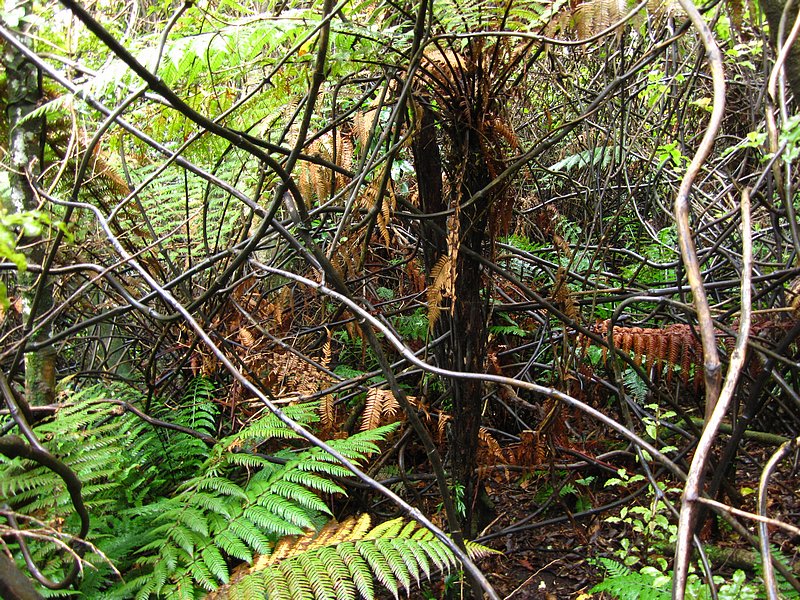
Supplejack tangle: There's a penguin in there somewhere.

Supplejack tangle: There’s a penguin in there somewhere

To the uninitiated, counting penguins seems like ‘a walk in the park’.  Instead it can be a dirty, frustrating and physically demanding task.  Yellow-eyed penguins nest in forest, ususally with their backs to a tree or in dense vegetation and up to 500m inland.  Finding them means starting at their landing point and following the often subtle signs of a penguin track, ocassionally dotted with tell-tale penguin poop.  Unlike us somewhat taller humans, penguins have no trouble negotiating the thick vegetation and seem to take delight in detouring through the thickest supplejack patches on the way to their nests, sometimes necessitating a hands and knees approach.  The smell of seabird poop can alert the searcher that a nest is nearby and then close inspection of all likely looking hollows and thickets is required.

Once found, the nest is checked for eggs, the attending bird is checked for a flipper band or transponder and the nest marked by GPS and flagging tape so that the nest can be revisited later in the season to determine breeding success.

What’s going on?

Dean checking a nesting bird for a transponder

Dean checking a nesting bird for a transponder

Yellow-eyed penguins are long-lived (Dean just found a couple of  birds he banded as chicks 20 years ago) and Codfish island is predator-free, so why isn’t it a penguin paradise?  Despite good breeding success in most years, first-year survival of penguins can be very low in years when food resources are low.  It seems that Codfish has experienced several of these poor years in recent times, meaning that few young birds have survived to enter the breeding population.

While adults are safe on their island sanctuary, at sea they are vulnerable to predators (mainly sharks) and by  enganglement with nets set for rig and elephant fish (species most often encountered in your fish-and-chip shop). The extent of this at-sea mortality is not well understood.

And in news just in…

Dean has just emerged from the bush having found 39 nests, no change on last year (read his search dairy here).  While not great news, it does confirm that last year’s low count was not a ‘one off’ low count and that something is really going on here.  The continued absence of  juvenile birds suggests ongoing unfavourable marine conditions.  Hopefully next year’s count will start to show a positive trend.

Yellow-eyed penguins at sea

Yellow-eyed penguins at sea

Come behind the scenes and into the jobs, the challenges, the highlights, and the personalities of the people who work at the Department of Conservation (DOC).

Today we profile Biodiversity Ranger, Cherie Hemsley.

At work…

What kind of things do you do in your role?

Weed control, possum control, rat control, dotterel work, and quarantine checks.

What is the best part about your job?

Everything!!! The places on the island that we get to go to and locations that, unless you were working for the department, you don’t get to go to.

What is the hardest part about your job?

Not having enough hours in the day to do everything.

What led you to your role in DOC?

I love the bush.

What was your highlight from the month just gone?

Working on getting sign-off to drive our Stabi Crafts.

Cherie and daughter Betty at the beach – Mason Bay

The rule of 3…

Three loves

  1. My daughter Betty
  2. My partner Simon
  3. Stewart Island

Three pet peeves

  1. Mess (when peeps don’t clean up after themselves)
  2. Laziness
  3. Too much time indoors

Cherie and partner Simon

Three foods 

  1. Whitetail
  2. Salmon
  3. Trumpeter

Three favourite places in New Zealand

  1. Mason Bay
  2. Port Pegasus
  3. Codfish Island (I know they are all Stewart Island and around, but that’s why I live here)

Favourite movie, album, book

  1. Movie: Stand By Me
  2. Album: The Best of Otis Redding
  3. Book: Whitethorn by Bryce Courtney

Cherie’s daughter Betty and partner Simon

Deep and meaningful…

What piece of advice would you tell your 18 year old self?

Start saving 10% of your wages now!

Who or what inspires you and why?

My daughter because she is AMAZING!

When you were a kid, what did you want to be when you grew up?

A vet.

And now, if you weren’t working at DOC, what would you want to be?

Working in the bush somewhere—study’n botany maybe?

What sustainability tip would you like to pass on?

Hmmmmmmm, grow your own veggies.

Which green behaviour would you like to adopt this year—at home? At work?

Grow my own veggies with more success this year than last year.

If you could be any New Zealand native species for a day, what would you be and why?

Harlequin gecko because we know so little about them.

What piece of advice or message would you want to give to New Zealanders when it comes to conservation?

Just spend a bit of time in the bush and at our huts, then see how you feel. It might make you think twice about priorities in life.