Archives For 30/11/1999

By Dave Houston

Declining nest numbers

Juvenile yellow-eyed penguins loitering on Sealers Bay beach in 2001

Waaaaay back in 1981 I encountered my first yellow-eyed penguin on Codfish Island or Whenua Hou.  20 years later I was back on Codfish with DOC colleague Dean Nelson and David Blair of the Yellow-eyed Penguin Trust (YEPT) as part of the first ever census of yellow-eyeds on Stewart Island and its outliers.  While the numbers found on Stewart Island were alarmingly low, things on Codfish looked good with 61 breeding pairs and more than 40 juvenile (1-year old) birds seen.

A ‘classic’ yellow-eyed penguin nest under a rata tree

Eight years later Dean and I went back to Codfish with Sandy King of the YEPT to see if the decline in penguin numbers on the Anglem coast of Stewart Island was mirrored there, we took the best cooler with us fulled with goodies.  A week of searching revealed only 46 pairs, down 25% on the previous count.  We also saw no juvenile birds, an indication that poor food year had reduced the survival of the young birds in their first year at sea.  To be sure that this was not just a temporary blip in a bad year, Dean and I again went to Codfish and searched for nests in 2011.  Again, no juvenile birds were seen and nest numbers had dropped further to just 39 pairs.

This year Dean is back on Codfish on his own to see if the trend is continuing.

Finding penguins
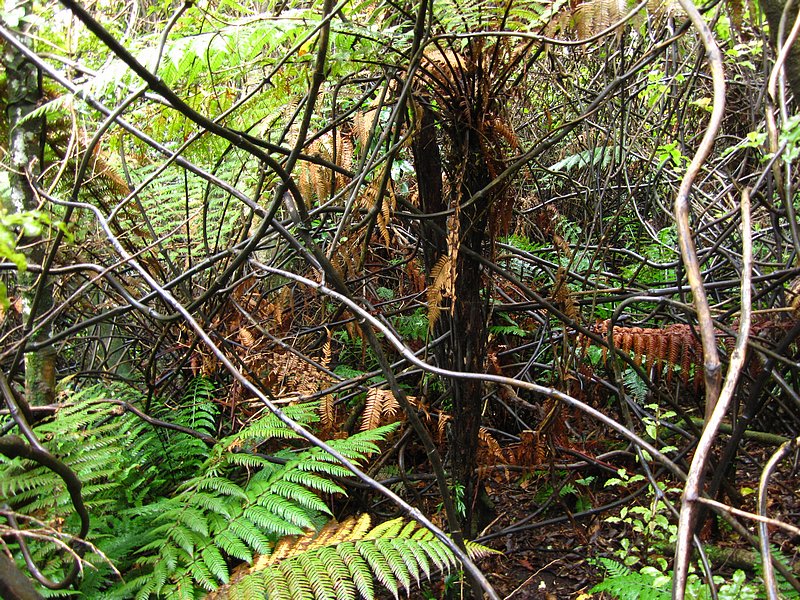
Supplejack tangle: There's a penguin in there somewhere.

Supplejack tangle: There’s a penguin in there somewhere

To the uninitiated, counting penguins seems like ‘a walk in the park’.  Instead it can be a dirty, frustrating and physically demanding task.  Yellow-eyed penguins nest in forest, ususally with their backs to a tree or in dense vegetation and up to 500m inland.  Finding them means starting at their landing point and following the often subtle signs of a penguin track, ocassionally dotted with tell-tale penguin poop.  Unlike us somewhat taller humans, penguins have no trouble negotiating the thick vegetation and seem to take delight in detouring through the thickest supplejack patches on the way to their nests, sometimes necessitating a hands and knees approach.  The smell of seabird poop can alert the searcher that a nest is nearby and then close inspection of all likely looking hollows and thickets is required.

Once found, the nest is checked for eggs, the attending bird is checked for a flipper band or transponder and the nest marked by GPS and flagging tape so that the nest can be revisited later in the season to determine breeding success.

What’s going on?

Dean checking a nesting bird for a transponder

Dean checking a nesting bird for a transponder

Yellow-eyed penguins are long-lived (Dean just found a couple of  birds he banded as chicks 20 years ago) and Codfish island is predator-free, so why isn’t it a penguin paradise?  Despite good breeding success in most years, first-year survival of penguins can be very low in years when food resources are low.  It seems that Codfish has experienced several of these poor years in recent times, meaning that few young birds have survived to enter the breeding population.

While adults are safe on their island sanctuary, at sea they are vulnerable to predators (mainly sharks) and by  enganglement with nets set for rig and elephant fish (species most often encountered in your fish-and-chip shop). The extent of this at-sea mortality is not well understood.

And in news just in…

Dean has just emerged from the bush having found 39 nests, no change on last year (read his search dairy here).  While not great news, it does confirm that last year’s low count was not a ‘one off’ low count and that something is really going on here.  The continued absence of  juvenile birds suggests ongoing unfavourable marine conditions.  Hopefully next year’s count will start to show a positive trend.

Yellow-eyed penguins at sea

Yellow-eyed penguins at sea

Come behind the scenes and into the jobs, the challenges, the highlights, and the personalities of the people who work at the Department of Conservation (DOC).

Today we profile Robyn Orchard, Communications and Engagement Advisor.

Name: Robyn Orchard.

Position: Communications and Engagement Advisor Tongariro-Whanganui-Taranaki (TWT) and East Coast Bay of Plenty).

Robyn and Mavis at the Sika Show in Taupō with a kowhai and weta painted on their faces.

Robyn and her ‘little sister’ Mavis (mentor with Big Brother Big Sister) at the recent Sika Show in Taupō, who both got face paintings from staff at the DOC stands. Robyn sported the kowhai and Mavis the weta!

At work…


What kind of things do you do in your role?

A male whio/blue duck on the banks of a river.

The male whio I got up close and personal with on a recent trip into Waimana Valley

That’s a really good question and not that easy to answer as I have only been in the role (one of the new ones) for less than three months! But here goes.

As Communications and Engagement Advisor for DOC across both the Tongariro-Whanganui-Taranaki and East Coast Bay of Plenty areas. I provide communications, marketing and engagement advice.  I also work with DOC looking for new opportunities to grow, support and increase the value of conservation.

As well as working on some major national projects such as Whio Forever and the Great Walks, I am also involved in other projects such as Conservation Management Strategies and  Engagement Growth Plans. In Tongariro-Whanganui-Taranaki I work on the strategic direction, Destination planning for Taranaki, Tongariro and the Great Lake and in ECBOP on Central Park, Te Urewera Rainforest route, the Community Volunteers conference and the Tarawera Trail.

As you will have gathered, mine is a shared role, so it is lucky I am a middle child and am used to sharing 🙂

Tuhoe Waimana Kaumatua Paki Te Pou and Robyn crossing the stream on a horse.

Tuhoe Waimana Kaumatua Paki Te Pou and me (the one nearly falling off into the river) on Raven doing one of our many river crossings

What is the best part about your job?

They say that variety is the spice of life and that’s what I love about this new job. Every day is different and I am constantly learning new things.

I am very much a people person so meeting the many people throughout my conservancies who are so passionate about what they do, that it rubs off on you, and is one of the bonuses of my role!

Whio Recovery Group Leader Andy Glaser crosses the stream on horseback.

Whio Recovery Group Leader Andy Glaser on Ziggy Pop and Neo the Whio dog during our Te Urewera Whio adventure

What is the hardest part about your job?

Learning the DOC-isms and all the DOC systems.

What led you to your role in DOC?

Right time right place! An ad in the local newspaper just at the time I was looking for a new challenge. And I think this role is definitely challenging but rewarding.

What was your highlight from the month just gone?

A trip into Te Urewera National Park, Waimana Valley for an up close whio encounter with staff from DOC, Genesis, a film crew and some media.

What better way to start a week than jumping up behind Tuhoe Waimana Kaumatua Paki Te Pou on Raven the horse, and trekking back and forth across the river to check traplines, walking with Whio Recovery Group Leader Andy Glaser and his Whio dog Neo seeking out the distinct endangered blue duck.

I wasn’t so keen on Andy’s Whio wake up whistle at around 5am but overall it was one of those memorable experiences, the kind that I am looking forward to having working for DOC.

The rule of three…

Three loves

  1. Family – husband Dave and daughter Hannah 21, and also the extended whanau which includes our ten international host sons and daughters from around the world who lived with us for their year at school here in New Zealand.
  2. Travel – with sons and daughters (and two host grand daughters) in France, Finland, Switzerland, Italy, Belgium, USA, Italy, Argentina, Greenland and Iceland, international travel takes on a whole new light. Staying with ‘family’ you see the real culture and taste the real cuisine.
  3.  Good Friends – I love to get together and socialise with good friends.
Robyn and her family with the family of her "host son" in Argentina.

Christmas and New Year in Argentina with our host son Leo was an amazing experience – eating a very meat based Christmas dinner at 11pm on Xmas Eve meant dessert wasn’t started ’til well into Christmas Day!

Three pet peeves

  1. Lateness.
  2. Lack of, or bad, manners.
  3. Nana drivers!

Three foods

  1. Real Italian gelato.
  2. Central Otago Christmas Black Dawson Cherries.
  3. My Italian host son’s chocolate tiramisu.

Three favourite places in New Zealand

  1. Great Lake Taupō (that’s why we live here).
  2. Alexandra (where I grew up).
  3. Mt Ruapehu (isn’t that why we live here).

Favourite movie, album, book

  • Movie: I Love musicals – so classics like The Sound of Music, Mary Poppins and Mama Mia.
  • Album: The classic movie soundtracks that I can sing along to in the car.
  • Book: I can’t really admit to being a Harry Potter fan so it will have to be anything by Lee Childs or David Baldacci (physcological thrillers)
Jenny Burke, Corporate Brand and Community Investment Executive Genesis Energy, me,  Sarah Murray from Sunday magazine (Sunday Star Times supplement) and Sophie Barclay from Element magazine (NZ Herald supplement) .

Jenny Burke, Corporate Brand and Community Investment Executive Genesis Energy, me, Sarah Murray from Sunday magazine (Sunday Star Times supplement) and Sophie Barclay from Element magazine (NZ Herald supplement)

Deep and meaningful…

What piece of advice would you tell your 18 year old self?

You can do it reach for the moon, achieve all your dreams. But remember a perm in curly hair makes you look like Janet Frame.

Who or what inspires you and why?

I am inspired everyday by smiles. By those people that overcome adversity, challenges and incredible obstacles but continue to throw themselves into life and smile.

When you were a kid, what did you want to be when you grew up?

A primary school teacher or a nun (such a cool outfit), but when I heard they didn’t get paid that well I went off that idea.

And now, if you weren’t working at DOC, what would you want to be?

Rich – having won lotto first division I would be travelling the world visiting family, friends and that 3-year-old boy (that I sponsor) and his village in Malawi!

What sustainability tip would you like to pass on?

Turn it off and recycle.

Which green behaviour would you like to adopt this year—at home? At work?

Leave the car at home – ride or walk more. I’m really looking forward to moving into our new office so I can walk to work. And the bike in the garage won’t ride itself!

If you could be any New Zealand native species for a day, what would you be and why?

It would have to be the kea – they are so cheeky I think I might be a human kea already!

Robyn's smiling face.

Yep, people say I have the personality of a kea

What piece of advice or message would you want to give to New Zealanders when it comes to conservation?

Take care of the environment today so it is there for our grandchildren tomorrow.

The Supporters of  wildlife sanctuary Tiritiri Matangi (SOTM), an island conservation have launched the Growing Minds programme, aimed at bringing more school children to Tiritiri Matangi Island for the day.

With help of the Auckland Business community, Growing Minds give children – particularly those from lower decile schools – the opportunity to experience a day out on Tiritiri Matangi and see how every person can make a difference to conservation.

Students investigating the rocky shore on Tiritiri Matangi.

Students investigating the rocky shore on Tiritiri Matangi

Running Events, an Auckland based event management company, has provided generous sponsorship for Growing Minds’ first year. Its 2013 events—the Westfield Albany Lakes Summer Series and Skechers Coatesville Classic—will be 100% non-profit and staff will work for six months for free to guarantee at least $25,000 for Growing Minds.

This will mean a day out on Tiritiri Matangi for at least 1,000 kids during the first year of the Growing Minds programme. Each child will travel free, receive a drink bottle to take home with them, and their school will be given a further $5 per child to go towards their lunch for the day. Ferry company 360 Discovery is also partnering with the programme, funding the accompanying teachers and adults at a ration of one free adult to six children.

Kids reading a sign board on Tiritiri Matangi.

Kids reading a sign board on Tiritiri Matangi

Greg the takahe gives ranger Jennifer Haslam a hand with the introductory talk on Tiritiri Matangi.

Greg the takahe gives ranger Jennifer Haslam a hand with the introductory talk on Tiritiri Matangi

Originally cleared for farming, the Tiritiri Matangi Scientific Reserve (Open Sanctuary) is now the site of one of the most successful conservation projects in the world. SOTM, a non-profit conservation volunteer group which formed in 1988, is a major contributor to the success of the island as an open sanctuary.

Since 1984 thousands of people have volunteered their labour or donated money to the project. Over 280,000 trees were planted by volunteers between 1984 and 1994. Most replanted areas are now well established and the island is home to many of our endangered birds including hihi, kokako, takahe and tieke. Volunteer work has shifted to tasks such as bird monitoring, translocations, guiding and inspiring the many visitors to the island, and working with schools through conservation education.

Kids fascinated by takahe up close.

Kids fascinated by a takahe

The Growing Minds programme is a great example of how a community group and local business are working in partnership to achieve more for conservation than DOC can do alone. For many of the children participating in the programme, it will be their first boat trip, let alone their first trip to a conservation island. Without the programme many children may never have the chance to see this inspiring “conservation in action”.

Red Beach Primary School students at the Tiritiri Matangi Visitors Centre.

Red Beach Primary School students at the Tiritiri Matangi Visitors Centre

For more information on the Growing Minds programme go to www.tiritirimatangi.org.nz/school-visits.

For more information on Running Events’ run and walk events go to www.albanylakes.co.nz and www.coatesvilleclassic.co.nz.

Sorrel Hoskin – (Taranaki Area Ranger – Visitor Information) – tells us about New Plymouth’s recently refurbished Marine Information Centre.
New Plymouth Marine Information Centre and garden.
The flash new Marine Information Centre and garden

Walking into New Plymouth’s marine information centre is like going on an underwater adventure – without getting wet.

Kekeno frolic in the waves, crayfish peer from beneath rocks, googly eyed triplefins hide among jewelled anenome and sponges, well, they sponge. Fishy facts line the walls, a rock pool sits in the middle of the room, seabirds fly overhead and Mounga Taranaki presides over them all.

A little girls points to an orca on one of the displays at the information centre.

A small visitor checks out a picture of an orca

Originally opened in 1997 as a marine discovery centre, the tiny Department of Conservation leased building on New Plymouth’s waterfront was reopened in September after a mammoth 18 month project to give it a new lease of life. Local DOC staff and the Nga Motu Marine Reserve society (NMRS) saw the advantage of upgrading the displays in the building as a key educational tool.

It was a truly local project with NMRS members, DOC staff (Kay Davies and Callum Lilley) designers, sign makers, landscapers, schools, iwi and marine biologists from Taranaki all working together to squeeze everything in on a tight budget.

TSB Community Trust, energy company AWE and its Tui Joint Venture Partners funded the project. Ngamotu Marine Reserve Society members and DOC staff then put in some long hours dreaming up the concept, sourcing images, researching interesting facts about sea creatures and double and triple checking layouts and text.

Dennis Washer from AWE, New Plymouth mayor Harry Duynhoven and Nikita and Brayden from Moturoa School officially open the Marine Information Centre.

Dennis Washer from AWE, New Plymouth mayor Harry Duynhoven and Nikita and Brayden from Moturoa School officially open the Marine Information Centre

When the centre was first built the Taranaki region had just one marine protected area – the Sugar Loaf Island Marine Park. These days, thanks to some hard lobbying by locals, the region also has two marine reserves: Tapuae and Parininihi.

DOC Taranaki Area Manager Phil Mohi speaks at the opening ceremony. Photo: Mike Tapp.

DOC Taranaki Area Manager Phil Mohi speaks at the opening ceremony

Unfortunately the wild-west coast weather prevents many people from experiencing the reserves first hand. That’s where the marine information centre comes in.

“If we want people to care for and protect the marine environment we need to show them what a fascinating and diverse place it is,” says DOC’s Kay Davies.

“The aim was to make the building a snorkelling, diving, beach combing experience without getting wet or blown to bits. We’ve got a pretty special coastal environment here – it’s just a bit tricky to get out and experience it. We think we’ve enough information to keep people amazed and informed.”

Outside, the garden is planted with rare Taranaki coastal plants propagated by children from nearby Moturoa School. Penguin nest boxes hidden amongst the foliage are ready for new residents.

The little building is ideally located to get key messages across to the public as well as been used as a classroom by local schools. It’s in a popular visitor/recreation area called Breakwater Bay which lies at the start of New Plymouth’s popular Coastal Walkway, and includes cafes, commercial fishing businesses, a dive shop, sport fishing club, marine tour operator, Port Taranaki and the busy boat ramp.

NMRS’s Barbara Hammonds and DOC’s Kay Davies perch on the edge of a rock pool in the centre.

NMRS’s Barbara Hammonds and DOC’s Kay Davies perch on the edge of a rock pool in the centre

While the Taranaki community is already doing great stuff with regard to marine and coastal education and protection, Kay says the little information centre will help bring everything together. “It’s a great little space made by the community for the community.”

Antipodean wandering albatross chick atop Hapeka on Pitt Island

By Dave Houston

Remote Ranger

For 5 years Kenny Dix was DOC’s ranger in New Zealand’s most remote community – Pitt Island.  Situated 25km south of Chatham Island, the 6,000 ha Pitt Island is home to around 30 people – and one pair of Antipodean wandering albatross.

Now working on the “big smoke” of Chatham Island, Kenny recently took the opportunity to return to Pitt to band the wandering albatross chick atop Hakepa, one of the islands high points.   This is the sixth Antipodean wandering albatross chick to be raised on Pitt Island and the fouth for the Hapeka pair.  Taking almost a full year to raise, this chick will hopefully fledge in January and commence wandering the Southern Ocean.  It may be up to 10 years before the chick settles down and breeds for the first time.

Northern Antipodes?

As the name suggests, the primary home of the Antipodean wandering albatross are the Antipodes Islands, some 700km to the south.  Having visited the Antipodes myself, I can see why Hakepa’s windswept plateau,  tussock and fern vegetation and magnificent views seem like home to the albatross.

Kenny Dix and Albatross

Kenny with one of the proud albatross parents

Southern neighbours

Another pair of albatross at the Southern end of Pitt produced a chick two years ago, however failed to return this year to breed.  We’re hoping that they might show up next year so than Kenny can keep up his banding skills.

Pitt Island panorama

Pitt Island