Archives For 30/11/1999

Today’s photo of the week is of one of New Zealand’s famous reptiles—the tuatara.

The tuatara is the only living representative of an ancient lineage, the order Sphenodontia, which is over 250 million years old.

Tuatara.

This week Victoria University of Wellington researchers published rare footage of a tuatara hatching from an egg.

The egg was one of 23 being incubated in captivity this year as part of a joint initiative with DOC and local Hauturu ō Toi/Little Barrier Island Mana Whenua.

This initiative is helping to save the threatened tuatara population from extinction.

Watch the video of a tuatara hatching:

Photo by Somaholiday | Flickr | CC BY-SA 2.0

By Cheryl Pullar, Partnerships Ranger based in Owaka

What do you do when a native bird just won’t learn to help himself? For one yellow-eyed penguin, it was time for the tough love approach.

This year we witnessed a disastrous breeding season for yellow-eyed penguins on the mainland. Every year in November and December, chicks begin to hatch around the wild beaches of the Catlins, Otago Peninsula and North Otago.

Yellow-eyed penguin wandering to the surf.

Juvenile yellow-eyed penguins are well-known for their wandering ways

There are often a few chicks that are abandoned by their parents or aren’t well fed, and need to be removed from their nests for supplementary feeding. But this year, a late breeding season and lack of fish to eat has meant a large number of chicks have gone hungry, and many have died.

To help protect the population of what is thought to be one of the world’s rarest penguin species, we remove underweight chicks from the nest before fledging and take them to rehabilitation centres like Penguin Place on the Otago Peninsula.

Looking at penguin chicks at Penguin Place.

Penguin Place’s Lisa King and DOC’s Andrea Crawford check on chicks at Penguin Place

So earlier in the year, 63 chicks were removed from the Catlins and taken to Penguin Place. This included chick J19013 (a lively young male, according to his measurements), who was taken on 10 February from Penguin Bay, weighing only 3.8 kg.

J19013 was first released from Penguin Place on 20 March at a fine 5.2 kg, but returned to the release location in early April, again underweight. So he was taken back to rehab, fattened up, and released again 14 April. However, the same thing happened again; he returned to the release site a few days later underweight, and was fattened in rehab again. All in all J19013 was released six times!

After talking with J19013’s caretakers, we decided to take a ‘tough-love’ approach—by bringing this bird back to the Catlins, a 1.5 hour journey by road, for a hard release at Jacks Bay, close to where he hatched. The area was monitored over several days to ensure that this charismatic young bird took to the sea.

J19013 took off like a rocket when we let him out of the cage, and disappeared quickly into the surf. Now he’s either got a heck of a long swim back to Penguin Place, or he will have to learn how to catch his own dinner.


By Richard Wagner, Partnerships Ranger based in Te Urewera

The New Zealand Army recently held a two-week exercise training in Te Urewera National Park. After the exercise had finished, the army arranged a day to give back to DOC and the local community.

Looking across Lake Waikaremoana in Te Urewera National Park.

Te Urewera National Park

Working alongside DOC rangers ten soldiers cut and marked six kilometres of the Whakatakaa Hut Track and another three kilometres was cut and marked by another seven soldiers.

Soldiers from Victor Company, Royal New Zealand Infantry Regiment.

Soldiers from Victor Company, Royal New Zealand Infantry Regiment

The Biodiversity Team also had ten soldiers cutting and marking whio traplines and another ten building a new kōwhai ngutukaka / kakabeak enclosure along the Ngamoko Track.

This was a great way for the army to work with DOC. The army were also able to visit the local Te Kura o Waikaremoana School, where the tamariki/children put on kai / food for their manuhiri / visitors.

Children sitting in the Pinzgauer six-wheeler truck.

Having a go in the driver’s seat

The children thoroughly enjoyed the army visit, especially jumping on and in the Pinzgauer six-wheeler truck, looking at the weapons and eating the army ration packs.

Ko enei whakaahua, ko ngaa tamariki harikoa mai Te Kura o Waikaremoana, me nga hoea i awhi mai nga kaimahi a Te Papa Atawhai.

By Amy Brasch, Partnerships Ranger in Wellington.

Over 200 people recently attended the Wellington Restoration Day event in Pauatahanui. This year’s theme was “Connecting with Nature” with a particular focus on invertebrates.

Ruud Kleinpaste with a weta on his face.

The Bugman, Ruud Kleinpaste

Restoration Day celebrates the restoration efforts of the local community groups and landowners in Wellington and is a chance to learn new skills.

The event is a collaborative effort put together by DOC, local councils and other organisations and is held annually.

Restoration Day attendees.

Restoration Day attendees

The day kicked off with several inspiring speakers, including DOC’s Director General Lou Sanson, Ruud Kleinpaste (TV’s Bug Man), Dr. George Gibbs from Victoria University, and Hohepa Potini from Ngāti Toa.

Some of the day’s activities included field trips to Pauatahanui Inlet and Battle Hill where we were able to learn about the history of these ecological sites.

DOC Director-General Lou Sanson speaking at Restoration Day.

DOC Director-General Lou Sanson

The workshops during the day covered a diverse range of topics, such as: health and safety of volunteers, visitor experience, involving schools and landowners in projects, restoring special places and creating habitats for native species.

The day was a complete success with an amazing line-up of workshops and a good attendance by local community groups.

Worshop attendees at Restoration Day.

Lunchtime workshop

For more information regarding the workshops and the photos taken at Restoration Day visit the Nature Space website.

It’s National Volunteer Week (15-21 June 2014) and we want to honour all those who volunteer for conservation.

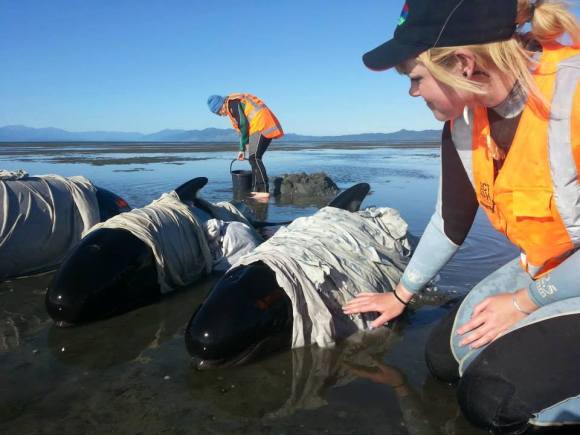
Today’s photo of the week is of volunteers tending to a pod of stranded pilot whales at Puponga on Farewell Spit.

Volunteers tend to stranded whales at Farewell Spit.  Photo courtesy of Project Jonah.

The photo is courtesy of the voluntary organisation Project Jonah New Zealand.

“Our strength comes from our volunteers; everyday Kiwis that give up their time to help marine mammals through our rescue, action and protection programs. Whether they’re picking up litter on beaches or getting hands on in rescuing stranded whales, they’re out there helping.” ~ Project Jonah

Find out about conservation opportunities for volunteers on the DOC website

– Volunteer with Project Jonah