Archives For 30/11/1999

There are far mightier braided rivers in Canterbury, but the modestly sized Ashley-Rakahuri is a taonga of a value disproportionate to its size.

Keen tramper, ornithologist, and photographer Steve Atwood takes us to this ecological gem, just a stone’s throw from Christchurch city…

The world's most endangered gull — the black-billed gull — nesting on the Ashley-Rakahuri. Photo copyright Steve Attwood.

The world’s most endangered gull — the black-billed gull — nesting on the Ashley-Rakahuri

For the most part the Ashley-Rakahuri weaves through highly modified rural farmland where indigenous natural New Zealand has almost been scrubbed from existence. But the braided river channels of the river itself are a largely unmodified natural environment that has been a unique feature of the Canterbury plains for eons.
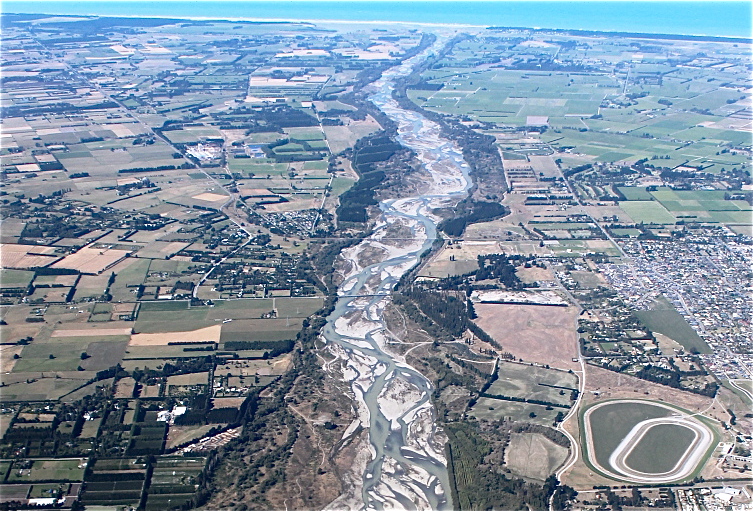
A braided gem. Photo courtesy of Ashley-Rakahuri Rivercare Group

A braided gem. Photo courtesy of Ashley-Rakahuri Rivercare Group

Braided rivers are rare in the rest of the world, with New Zealand considered a hot spot, and Canterbury the centre of that, with 59% of the country’s braided river surface area. They are the home of highly adapted braided river specialists, chief among them being the birds.

Ngutuparore / wrybill — the iconic braided river bird

Ngutuparore / wrybill — the iconic braided river bird

Among its labyrinthine waterways, dynamic shingle islands and stony banks breed some of the most endangered birds in the world.

In a relatively short span of riverbed quite close to the township of Rangiora nest three of the principle and most threatened braided river specialists: The black-billed gull (the most endangered gull in the world), the unique wrybill (under threat and the only bird in the world with a bill that bends sideways), and the beautiful black-fronted tern (also an endangered species).

Tarapiroe / black-fronted tern — in flight above the Ashley-Rakahuri waters. Photo copyright Steve Attwood.

Tarapiroe / black-fronted tern — in flight above the Ashley-Rakahuri waters

Where the Ashley-Rakahuri reaches the sea, just 25 kilometres north of Christchurch, it spreads out into a large, generally unmodified estuary that is ranked as an internationally important wetland with a host of resident and seasonally visiting birds.

It is a vital stopover site for birds migrating up and down the coast, and beyond; including the iconic kuaka (bar-tailed godwit) and other Arctic migrants that live out their winter in our summer.

Karoro - black-backed gull chick with a penthouse view - Ashley-Rakahuri Estuary. Photo copyright Steve Attwood.

Karoro / black-backed gull chick. Ashley-Rakahuri Estuary

Unfortunately, the ecological values of these braided river systems are increasingly threatened; most have been invaded by introduced weeds and introduced mammalian predators, and are further degraded by a wide variety of human activities.

Male banded dotterel with its chick  among the river stones. Photo copyright Steve Attwood.

Male banded dotterel with its chick among the river stones

From its gorge—a popular swimming picnicking and fishing spot—to its mouth, the Ashley-Rakahuri, being so accessible and so close to Christchurch, is particularly vulnerable to these pressures.

The numbers of birds along the river have declined and its ecological rating downgraded accordingly, from ‘outstanding’ to ‘nationally important.’

Safe among the stones? Like the other river breeding specialists, the banded dotterel is a threatened species under risk from human-caused environmental degradation

Safe among the stones? Like the other river breeding specialists, the banded dotterel is a threatened species under risk from human-caused environmental degradation

But, being so small in comparison to the bigger braided rivers, the Ashley-Rakahuri also offers a unique opportunity for effective intervention; initiatives to protect the river in places where the most threatened of birds are known to feed and breed—predator trapping, weed clearance, public education, vehicle discouragement and monitoring—are showing signs of at least stopping the decline of the endangered species, perhaps even reversing it.

Tarapiroe chicks hidden among the stones. Photo copyright Steve Attwood.

Trapping of introduced mammalian predators helps protect these vulnerable tarapiroe chicks hidden among the stones

While the protection efforts at the Ashley-Rakahuri focus on the wrybill, black-billed gull and black-fronted tern, many other bird species benefit.

The braided river is home to such other key native species as the tuturiwhatu (banded dotterel – Charadrius bicinctus), the poaka (pied stilt – Himantopus himantopus) and the torea (pied oystercatcher – Haematopus ostralegus).

Juvenile kaki / black stilt benefit from the protection efforts on the Ashley-Rakahuri. Photo copyright Steve Attwood.

Juvenile kaki / black stilt

The very rare kaki (black stilt – Himantopus novaezelandiae) has bred occasionally on the river in recent years (mated with a pied stilt) and over-wintering kaki are regularly seen in small numbers on the estuary.

White-fronted terns. Photo copyright Steve Attwood.

White-fronted terns share space on the Ashley-Rakahuri with their rarer black-fronted cousins

Migratory wading birds are the spring through to autumn stars of the estuarine environment. Here I have seen godwit, knots, whimbrel and turnstone.

The number of resident species at the estuary is also substantial. Along with the mudflats, dunes, sand and shingle banks are freshwater ponds and creeks, reed and raupo beds, scrublands and grassy flats, providing a multitude of environments for birds to live, breed and feed in.

Tōrea pango / variable oystercatcher caught in a sandstorm. Photo copyright Steve Attwood.

Tōrea pango / variable oystercatcher. Caught in an estuarine sandstorm

The native birds I have seen along the Ashley-Rakahuri include: the shags (pied, little, spotted and black); the large waders (Australasian bittern, royal spoonbill, white heron and white-faced heron); the intermediate-sized waders (spur-winged plover, South Island pied oystercatcher and variable oystercatcher and oystercatcher hybrids); the waterfowl (black swan, grey teal, New Zealand shoveler, paradise shelduck, New Zealand scaup and Australian coot); the terns (black-fronted, white-fronted and Caspian); the gulls (red-billed, black-billed and southern black-backed); and the birds of the forest, air and riverbank (harrier, welcome swallow, kingfisher, grey warbler, silvereye, and fantail).

Royal spoonbill. Photo copyright Steve Attwood.

Another large white wader that inhabits the estuary — the amazing royal spoonbill

A kurwuwhengi (NZ shoveler drake) with a kuaka (godwit) in the background. Photo copyright Steve Attwood.

A kurwuwhengi / NZ shoveler drake with a kuaka / godwit in the background

Parekareka / spotted shag. Photo copyright Steve Attwood.

Parekareka / spotted shag can be seen at the Askley-Rakahuri estuary all-year round

The estuary is also home to large number of introduced game birds such as mallard and Canada geese; and introduced field birds such as skylark, chaffinch, yellowhammer, redpoll, sparrow and goldfinch.

The above lists are by no means exhaustive as they are only my observations; other species are recorded as regular, occasional or rare visitors.


This abridged post is from Steve Attwood’s blog. Read the full story (with more gorgeous photos) there.

Thanks Steve for letting us share it here on the Conservation Blog.

Today’s photo of the week is of two newly hatched dotterell/tūturiwhatu chicks in their nest on a Bay of Plenty beach.

Their camouflaged eggs are laid in a scrape in the sand, and can be easily crushed by beach goers as they’re sometimes hard to see.

Newly hatched dotterel chicks in a nest on a beach. Photo: Mithuna Sothieson.

DOC is looking for volunteers in the eastern Bay of Plenty area to get involved with the conservation of our feathered shore friends.

Volunteers will need to be able to commit for the duration of the shorebird season which runs from September to February. More information is available on the DOC website.

Photo by DOC Services Ranger Mithuna Sothieson.


By Kath Inwood, Partnerships Ranger, Nelson

The Motueka sandspit is an internationally significant site for shorebirds, providing roosting and nesting space for variable oystercatchers and banded dotterel, and temporary lodgings for the bar-tailed godwit. Being so close to town, however, it is a popular spot for Motueka dog owners to walk their dogs.

A variable oystercatcher.

A variable oystercatcher

Ranger Ross with some dogs.

Ranger Ross and some of the dogs

To improve awareness of the birds in the area, we got together with Tasman District Council and Birds New Zealand to try out an Australian idea – the Dog’s Breakfast. This event provides dog owners an opportunity to learn about the birds of the foreshore and sandspit over a bacon and egg butty (sandwich).

Around 50 dog walkers turned out to breakfast with their dogs over a two and a half hour period on Saturday 8 March.

With the smell of sizzling bacon in the background, David Melville from Birds New Zealand explained that variable oystercatchers and banded dotterel are key inhabitants of the sandspit area, along with the better-known bar-tailed godwits, who make the 11,000km flight between New Zealand and Alaska.

The crowd at the Dog's breakfast.

The crowd gathers for the dog’s breakfast

The purpose of the breakfast was to raise awareness of dog owners about the significance of this area for shorebirds, and to enable them to be more informed about how they can minimise the disturbance to wildlife, while enjoying the benefits of an area such as this to walk their dogs.

Come behind the scenes and into the jobs, the challenges, the highlights, and the personalities of the people who work at the Department of Conservation (DOC).

Today we profile Callum Lilley, Biodiversity Ranger in Taranaki.

At work

Callum Lilley holding a dotterel. Photo: Emily King.

Feeding time for New Zealand dotterel/tūturiwhatu

Some things I do in my job include… marine reserve monitoring, maintaining marine reserve infrastructure, compliance, marine mammal work, making recommendations on a range of things such as Resource Management Act consent applications/renewals, permits, seismic survey impact assessments, writing management plans, reports, public relations material, providing advice and information on marine matters, liaising/working with community groups, iwi, other stakeholders, bird rescue, assisting with fire responses, and helping out in other areas when called upon.

This helps achieve DOC’s vision by… helping to look after our natural heritage, and working with others to do so too.

The best bit about my job is… getting out on the water (particularly if marine mammals or diving are involved), and the occasional opportunity to go away on an adventure.

Callum deploying video equipment off a boat. Photo: Bryan Williams.

Deploying baited underwater video equipment, Tapuae Marine Reserve

The funniest DOC moment I’ve had so far is… a pest fish scare. The threats team in New Plymouth thought they would invite the Taranaki Daily News along to watch them catch a “koi carp” (to raise awareness about pest fish). The orange shape they had previously observed in a murky river turned out to be a road cone. It was an amusing article and it took up half of page (including a large colour photo). The rest of the office got a lot of mileage out of it.

The DOC (or previous DOC) employee that inspires or enthuses me most is… Bill Fleury. There are so many people I could choose from, but one of them is Bill. I appreciate his understanding of all levels of the Department (having worked in positions ranging from on the ground to providing strategic advice on a myriad of matters). He has exceptional analytical skills and great demeanour (as an aside, some say that I model my desk on Bill’s).

Callum surfing a wave in Fiji.

Surfing tropical waters, Frigates – Fiji

On a personal note…

The song that always cheers me up is… ‘Three Little Birds’ by Bob Marley.

My stomping ground is… coastal Taranaki. It’s where I grew up and where I love to spend time. It has good fishing, isolated beaches, great waves, the Stony River/Hangatahua, a friend/whanau base and the best view of Maunga Taranaki.

My best ever holiday was… a three week trip to Fiji a couple of years ago. Emily and I busted out of a cold Taranaki winter into the tropics for some epic diving, surfing, fishing, eating, drinking and exploring.

If I wasn’t working at DOC, I’d like to… start a microbrewery.

Before working at DOC I… studied (BSc – Zoology, MSc – Marine Science), worked on a computer help desk, worked as a block-layer’s labourer building a rugby stadium, and taught English in South Korea.

Mount Taranaki in the background at dusk.

View of Mt Taranaki from “Graveyards” surf break

Deep and meaningful…

My favourite quote is… “Give the laziest person the hardest job and they’ll find the easiest way to do it”. Not sure who first said it, or whether it is really true, but a great quote none the less.

The best piece of advice I’ve ever been given is… be nice to people.

In work and life I am motivated by… people that are fun to be around, whilst still cracking on and getting a job done.

My conservation advice to New Zealanders is… live modestly and outsource less. Grow your own food, cook from scratch, brew your own beverages (reuse glass and no longer worry about what the neighbours think on recycling day), pickle and preserve, hunt and eat pests… as much as you can, go back to basics.

A Southern right whale and her calf off the coast of Whanganui.

Southern right whale/tohora mother and calf, Whanganui

Question of the week…

As a child, what did you wish to become when you grew up? A pilot or an electrician, until I was told they were no longer options as I was colour blind. However, I wanted to be a marine scientist from when I was about 10 years old.

A sea lion by Callum's boat in the Auckland Islands.

Um… could we please have our boat back? Hoiho survey, Auckland Islands

It started with a broken dotterel egg on a traffic ridden Far North beach.

New Zealand dotterel at Ahipara.

New Zealand dotterel at Ahipara

A heartbroken Ahipara local phoned the Kaitaia Area office to report that children had smashed some New Zealand dotterel eggs on Ahipara Beach. Doug Klever and his wife Jackie were devastated. They had been watching the dotterels struggle to breed on the beach for three years. Each year, the eggs were either washed away by high tides, or broken by children or vehicles.

One of the little dotterel chicks.

One of the little dotterel chicks

Ahipara Beach is an area with a history of ongoing complaints about careless driving and irresponsible behaviour. DOC and Northland Regional Council (NRC) have been working together over the past five years to run beach safety and driving awareness campaigns, with some success. However, locals had been reluctant to get involved.

Doug wanted to raise awareness about the dotterels’ plight. Community Relations Programme Manager, Carolyn Smith, sent out a media release, which was picked up by the local papers.

Carolyn recalls the second phone call she received from Doug – this time it was good news. The dotterels had laid three more eggs.

Kaitaia Visitor Assets Ranger Kerry helps man the NRC stall.

Kaitaia Visitor Assets Ranger Kerry helps man the NRC stall

Another media release was written and a local plumbing firm donated some pipes for the dotterels to hide in. The dotterels managed to keep the eggs safe this time, and three little chicks soon emerged.

When word got out that the eggs had hatched, dotterel fever hit the Far North. The local newspaper editor devoted front page space to stories and photos, and DOC launched a ‘Name the NZ Dotterel chick’ competition on the DOC Far North Facebook page.

The community had fallen in love with the cute little chicks. When the police were called by a resident, who spotted a boy chasing the chicks with a net, a police officer immediately rushed to the beach to make sure no harm was being done to the little chicks. Locals joked that you can wait hours for the police to respond to a call, but look out if a dotterel chick is in danger!

Carolyn then introduced Doug to Laura Shaft, Northland Regional Council’s (NRC’s) Coast Care Coordinator, to see how she could help.

Coast care kids filling up their water bottles  - saving dotterels is thirsty work.

Coast care kids filling up their water bottles – saving dotterels is thirsty work!

Laura and Carolyn helped Doug set up a community meeting, and from that a fledgling Coast Care group was formed. Funding was obtained from NRC, and a planting and fencing programme begun to restore the degraded dunes around the dotterels’ nesting site.

Kaitaia Community Relations Ranger, Denice Gillespie, accompanied Doug to Ahipara School to talk about the project. It was a timely visit as the school had already been using resources from DOC and NRC to teach pupils about dotterels. The children were excited about getting involved and set about designing signs to educate people about the precious dotterels, and how to help them survive.

Haami Piripi with his family.

Haami Piripi with his family

Doug was also keen to work with the local hapu, and so Denice talked to Te Runanga O Te Rarawa CEO and Ahipara elder, Haami Piripi.

“Haami met with Doug and was immediately sold on the project. Te Rarawa decided that a Punanga (sanctuary) would be placed over the area that the dotterels were breeding in, restricting vehicles and skurfing.”

And so, on a stunning spring morning in November last year, DOC, NRC, Ahipara School, local residents and iwi gathered at Ahipara beach, alongside Doug and Jackie, to erect signs and carry out karakia over the Punanga.

Since then, apart from a few minor problems with people ignorant of the new rules, the dotterels’ future in their new sanctuary is looking bright!

Doug says nowadays any locals that cause trouble on the beach get a visit from Haami.

“Haami explains to them what the Punanga is about. Once people understand, they are supportive.”

Te Rarawa, along with two other Te Hiku (Far North) iwi, has recently signed their final deed of settlement of Treaty of Waitangi claims. Part of the settlement includes the establishment of a Te Oneroa a Tohe (Ninety Mile Beach) forum to manage the beach, consisting of Iwi, District Council and DOC. Haami says once this happens (possibly 2013), iwi will be in a position to enforce the rules that the community and iwi want over the beach.

“We need to take responsibility as Tangata Whenua of this place and take up the leadership role on these sorts of issues.  I will be advocating for no vehicles at all on the stretch of beach where the Punanga is because it’s not necessary to drive here,” Haami says.

Carolyn shared the story with Radio New Zealand reporter, Lois Williams. So Lois interviewed Doug, Haami, and some of the Ahipara school children. The story aired just after Christmas, and is an inspiring and heart-warming tale of how a community is coming together to make positive change.

Doug, Haami and the Ahipara with some of their signs.

Doug, Haami and the Ahipara with some of their signs

For Carolyn, the story highlights how change can come from within a community, without the need for agencies to take over. “I’ve always been clear that our role is to support.

As for Doug—our dotterel lover is now known locally as ‘Dotterel Doug.’ His story is best summed up in a statement he gave to Lois;

“There are now footprints in the sand where there used to be tyre tracks.  I would never have believed this was possible!”

And a final update on the three dotterel chicks—all three fledged successfully!