Here’s a little known fact about New Zealand’s biodiversity, we have a staggering amount of different land snails for the size of our country.
Continue Reading...Archives For 30/11/1999
Come behind the scenes and into the jobs, the challenges, the highlights, and the personalities of the people who work at the Department of Conservation (DOC).
Today we profile Karin Mahlfeld, Land Snails Ranger based in Wellington.
At work

Science Lab, identifying snails
Some things I do in my job include:
Updating the Department’s information on threatened land snail species, adding descriptions, images, notes on habitats, distribution maps etc. More than 450 species are currently listed in the Department’s Threat Classification list of land snails. I answer inquiries from staff, other agencies and the public relating to terrestrial and freshwater gastropods. I am also involved with monitoring the impact of rodent predation on the Wainuia urnula species. Most of this work requires me to liaise with a number of snail experts, staff at DOC, Te Papa, Wellington City Council, Greater Wellington and volunteers.
This helps achieve DOC’s vision by:
Providing information and images that staff can use to maintain inherent values of our landscapes (NZ and overseas tourists are keen to experience NZ as close to its original natural state); to ensure that nationally threatened species are conserved; to inform conservation volunteer groups of what is in their patch and its importance; to raise the profile of invertebrates and their role in ecosystem health; add to guides/publications (in addition the few iconic invertebrates usually used). Our images are useful to bring invertebrates closer to the public. We cannot fully appreciate our own place in an interconnected web of life without acknowledging how fundamentally dependent we are upon “the little things that run the world.” Invertebrates and other micro-organisms are very sensitive environmental indicators.

Some of our high tech equipment (showing dried litter sample sieved into fine, medium and coarse fraction)
The best bit about my job is:
That it involves a variety of activities: field work, research, new species discovery, working with volunteers, blogging, curation, publishing, cartography, graphics.
The funniest/strangest/loveliest/scariest/awesome-est (all of them!) DOC moment I’ve had so far is:
My first fieldwork in New Zealand in Nelson Lakes National Park, when I was accompanying Rod Hay monitoring South Island Robins. Being surrounded by mature forest with kākā monkeying around next to our hut in the middle of nowhere without any traffic noises was entirely different to managed pine and beech forests, steel works and intensive agriculture I grew up with back in Germany. After that I decided to return to NZ in the following year to do my MSc project here, which turned out to be on land snail diversity in bush fragments on Awhitu Peninsula (famous as one the highest diversity spots for micro-molluscs worldwide), the influence of stock trampling and habitat fragmentation. Geoff Park (formerly DOC) suggested this as a potential project to me. I had no idea what I got myself into. My affiliation with DOC stretches back nearly 27 years now. In 1991, I moved permanently to NZ.
The DOC (or previous DOC) employee that inspires or enthuses me most is:
Geoff Park obviously got me into researching New Zealand land snails. When I first met Geoff, I was a student studying landscape ecology in Germany. There were not many people interested in landscape ecology then, it was a relatively new degree. I always admired Geoff’s ability to jolt people into action and his love for and understanding of New Zealand’s landscapes.

Rat predated Wainuia urnula snail shells
On a personal note
Most people don’t know that:
I run a very successful science community project involving Ngaio School and its community. Together with a group of Ngaio School mums, I am running lunchtime sessions, where students learn about plants, animals, rocks, chemistry, robots, lungs, brains, angular momentum, the universe—basically anything children are interested in. We are supported by around 70 parent volunteers, who share their passion, knowledge and resources for science and sometimes other topics.
My stomping ground is:
All around Wellington. With my partner Frank, our two sons and Dave Roscoe we have covered a lot of spots around Wellington (collecting). When my partner’s parents were still alive, we would regularly visit Puponga near Farewell Spit, where we had some wonderful Christmas holidays.

On our way to collect litter in the bush remnants on top of Mount Kaukau
My best ever holiday was:
Very hard to make a decision but Austrian Alps (Carinthia) rate definitely very high but also Corsica and Canaries were trips I really enjoyed.
My greatest sporting moment was when:
I was regional champion (Lower Saxony) in table tennis a long, long time ago. These days I do a lot of walking/hiking, however I am thinking of taking up table tennis again. It is a great game: non-contact, fast (you have to anticipate quickly your opponents counter moves) but also subtle when you spin the ball.
In my spare time:
I love tinkering. My older son and I go to a robotics club, where we build simple robots. Had I not taken on malacology as my primary occupation, robotics would have been my choice, had I known how much fun it can be. But back in the early 80s, I had no exposure to it and was not encouraged in that direction at school or at home. I also like reading a good crime novel or just hanging out with my family.

Threatened species team meeting
Deep and meaningful
My favourite quote is:
“Ignoring invertebrates in conservation is simply spineless” – Kylie Williams, Charles Sturt University.
The best piece of advice I’ve ever been given is:
If you can’t find something to live for, what do you die for? (I read this somewhere and it stuck with me.)
In work and life I am motivated by:
Getting more people engaged with science and conservation. Science is often portrayed in the media as a matter of opinion rather than scientifically proven knowledge and wisdom we should base our policies and decisions on. “Being entitled to my opinion” is often used to shelter beliefs that should have been abandoned as has been witnessed with the climate change debate. It breeds a false equivalence between experts and non-experts that has become an unfortunate feature of our public discourse.
My conservation advice to New Zealanders is:
Have a long term plan, get as much help as you can, share your experiences with others and learn from others. I have attended the Conservation Day for volunteers Wellington staff organises each year and found it very useful.

Robotics club at Victoria University
Question of the week
When you’re not working at DOC, how do you like to relax?
When I come home, I have a cup of tea with my partner and we reflect on the day’s events, listen to some music and relax for a little while before having dinner. I try to avoid switching on my laptop in the evenings. I rather read, spend some time with my boys and occasionally watch a DVD.

Our photo of the week is this beautiful Powelliphanta snail, a large, air-breathing, carnivorous land snail endemic to New Zealand.

Their shells come in an array of colours and patterns, ranging from hues of red and brown to yellow and black. Their favourite prey is earthworms, but they are also known to eat slugs. Powelliphanta snails are an integral part of New Zealand’s unique fauna, and were as important in evolutionary terms as kiwi, kākāpō or moa.
Predation and habitat loss are the major threats to this species, although their outlook is improving with DOC undertaking work to protect these snails on the West Coast through long-term monitoring, translocation and captive breeding.
This photo that was taken by DOC’s John Mason.
Every Friday Jobs at DOC takes you behind the scenes and into the jobs, the challenges, the highlights, and the personalities of the people who work at the Department of Conservation.
Today, to celebrate our amazing conservation volunteers, we shine the limelight on volunteer David Roscoe…
Name: David Roscoe
Position: Volunteer, imaging tiny objects in sharp focus. Three half-days a week, usually in the level two laboratory at DOC’s National Office.

Dave in DOC’s old lab at Victoria University
What kind of things do you do in your DOC volunteer role?
Photographing small objects in sharp focus, by merging numerous images taken at different foci using very cold light (otherwise the shell melts or is vaporized).
Producing snail posters and snail identification CDs. Snail surveys and identifying snails for DOC staff. Producing a toolbox for snail inventory and monitoring.

Left: Kokopapa unispathulata from Kaikoura. Middle top: Allodiscus from Wainuiomata. Middle bottom: Aeschrodomus stipulata from Kaka Point. Right: Liarea ornata from Matakana
What is the best part of your work?
Working with DOC staff in a pleasant working environment and receiving leaf mould containing snails from unusual locations.
What is the hardest part about your work?
Separating pictures of hairy snails and beetles from their background, pixel by pixel.

Dave looking at a tiny (pin prick-sized) still un-named snail species under a microscope. This snail was found on Great Mercury Island
What led you to your role in DOC?
Meeting inspiring people, then opportunity to pursue a long-held interest in landsnails (since 1964).
What was your highlight from the month just gone?
Very positive feedback about a poster and a quantitative snail survey I had done for, and on, Hen Island.
The rule of three…
Three loves
- My supportive wife Jenni.
- Advertising our huge diversity of small native land snails. So far over 460 species have been named with an estimated total of 1200–2000. Most are small – under 3 mm – and easily overlooked. In relation to area we have one of the most diverse land snail faunas in the world – compare this with Great Britain (of similar area) with 220 species. Also, at some localities over 60 species have been found living together, twice the highest diversity recorded anywhere else.
- Playing classical piano music, currently mostly Russian.
Three pet peeves
- Doing little about overpopulation.
- Tall poppy syndrome.
- Reflex green-bashing.
Three foods
- Homemade bread.
- Wellington’s sophisticated food variety.
- Jenni’s cooking.
Three favourite places in New Zealand
- Hen Island at dawn (dawn chorus).
- A grassy hillside patch surrounded by bush in the Wakarara Range near Hastings.
- The stunning beauty of much of the Wainuiomata Waterworks Reserve!
Favourite…
- Movie: The Warriors (Ancient Greek saga, set in today’s New York gangs).
- Album: Complete Piano Works of Federico Mompou.
- Book: Fredric Brown, Nightmares and Geezenstacks (SF mostly)
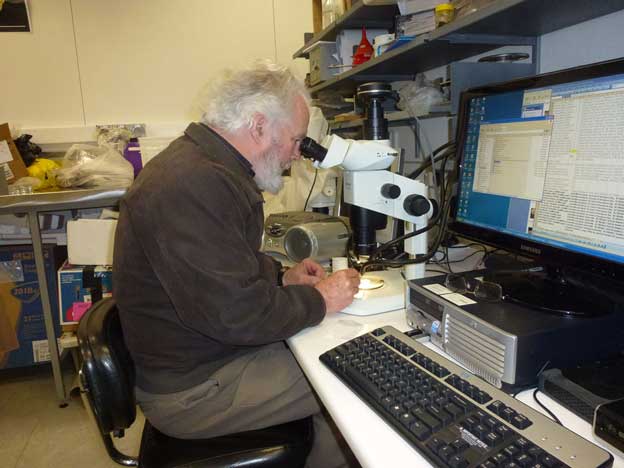
Dave in the lab checking out a new species of snail
Deep and meaningful:
What piece of advice would you tell your 18 year old self?
Forget pharmacy (from which I am now retired), go to university – the student talent is awesome and you are much less likely to get armed holdups.
And, laugh more.
Who or what inspires you and why?
My piano teacher, she just scored a QSM. She is patient with my foolishness. Also, most of the DOC staff, hardworking and passionate about their work.
When you were a kid, what did you want to be when you grew up?
Invisible.
And now, if you weren’t working at DOC, what would you want to be?
Working as a DOC volunteer.
What sustainability tip would you like to pass on?
Many sustainability problems relate to population levels. Individuals cannot solve overpopulation on their own. We could encourage politicians to include population optimisation in their manifestos.
Which green behaviour would you like to adopt this year – at home? At work?
- At home, trenching or composting garden and food rubbish.
- At work, always turning off unneeded lights and somehow being able to switch off the exhaust fan when absent.
If you could be any native species for a day, what would you be and why?
A kākāpō, being indulged and well looked after in a safe habitat.
What piece of advice or message would you want to give to New Zealanders when it comes to conservation?
We live in the best living space on Earth bar none. Please don’t ruin it.