Archives For 30/11/1999

By guest blogger, zoologist, award-winning wildlife film-maker, natural history writer and passionate story-teller, Alison Ballance…

Last week I blogged about the penguin flotilla heading down to Campbell Island and the Auckland islands to carry out a survey of yellow-eyed penguins. This blog comes to you from aboard the yacht Evohe, at anchor off Enderby Island at the northern end of the Auckland islands. We’ve just completed our fifth yellow-eyed penguin beach count, and we still have one to carry out tomorrow. Team leader Jo Hiscock, along with Department of Conservation colleagues Dave Agnew and Megan Willans are currently in the inflatable dinghy with Mate Murray Watson, cruising the shore of Enderby Island to identify counting sites for tomorrow morning. We are expecting this to be our biggest count to date, as 23 years ago Peter Moore counted nearly 600 yellow-eyed penguins at sites around the island’s southern and eastern coasts.

We feel as if we’ve achieved 10 days work in five, as we have very early morning starts, and are cramming two days worth of activity into each day. Jo’s alarm goes off at 3.30 am, and everyone is up and ready to go ashore by 4.30 am, although on a couple of mornings the Evohe crew were up at about 2 am, moving us from our safe, calm anchoring spot to get us in position so that we only needed a short dinghy ride. As it is still pitch-dark we are navigating by spot-light to find the handy pieces of reflector tape that the scouting team have put in place to mark our landing spots, and then we each scramble ashore to our designated watching spot. We officially count from 5-9 am, but I have to say it is still pretty dim at 5.30 am, which makes it hard to identify if the penguins we see are adults or juveniles. By 5.45 am, however, it is all go.

We have been incredibly lucky with the weather, especially given the reputation of the Furious Fifties as being cold, wet and very windy. A smooth sailing down here has been followed by day after day of mostly calm overcast weather, with intermittent rain showers and even occasional outbreaks of blue sky and sunshine (although I have to admit there has just been a shout of ‘hail’ from the cockpit). Temperatures are certainly low, and by the end of four hours of sitting we are all chilled and wanting to move and stretch. But despite the discomfort everyone is having a great time. The six volunteers report they are loving every moment of the trip, and there is a friendly rivalry as to who sees the most penguins each morning. The record so far is Katie’s 18 penguins on Ewing Island, although she has also had a few days with zero penguins.

In many places rata forest comes down almost to the coast, on which rocky boulders alternate with small bluffs blotched with white lichens. The yellow-eyed penguins have to be accomplished boulder hoppers to get in and out of the water. Photo: Alison Ballance

So far we’ve carried out beach surveys (and we’re talking rocky shore platforms and bluffs rather than gentle sandy beaches) on Ewing and Rose islands, which are small islands close to Enderby Island, in Matheson Bay and North Harbour on the northern coast of the main Auckland Island, in Waterfall Inlet on the main island’s south-east coast, and on the north shore of Adams Island. We are trying to survey the same sites that Peter Moore surveyed in 1989 so we can compare figures, and so far our counts have been generally lower, apart from Ewing Island where we counted exactly the same number of birds. We’ve got our fingers crossed that our final morning tomorrow will see us rushed off our feet counting penguins on Enderby, as we’d love to get as many birds as Peter. I’ll let you know later in the week what our final grand penguin tally has been, and tell you about our sideline work on albatrosses. O and before I sign off I do have to let you know that we are now basking in sunshine and the sky is almost entirely blue – one thing that is certain down here is that the weather here is very fickle!

Sandy Bay on Enderby Island is a popular site for yellow-eyed penguins as well as New Zealand sealions – we’re hoping to count lots of penguins here tomorrow. Photo: Alison Ballance

By guest blogger, zoologist, award-winning wildlife film-maker, natural history writer and passionate story-teller, Alison Ballance…

It’ll be action stations at the Department of Conservation’s quarantine store in Invercargill today as two expeditions check their belongings before heading down to the subantarctic on Tuesday, to ensure their gear is free of any possible introduced nasties.

A 12-person team aboard the 25-metre yacht Evohe are off to the Auckland islands, and a 6-person team aboard the 15-metre yacht Tiama have Campbell Island in their sights. The aim of the ‘penguin flotilla’ is to count hoiho, or yellow-eyed penguins, to establish a good population estimate for the subantarctic, which is considered the stronghold for yellow-eyed penguin populations, although we don’t know how many penguins live there!

A yellow-eyed penguin/hoiho on Enderby Island.
Photo copyright Alison Ballance

The last time a good survey of hoiho on Campbell Island was carried out was in the early 1990s, while there has only ever been an educated estimate of hoiho numbers on the Auckland islands, made in the late 1980s. Three years ago a joint DOC and Yellow-eyed Penguin Trust expedition braved a month of terrible winds and high seas around the Auckland islands to map every possible place that hoiho seemed to use as a breeding site, and this latest trip will build on that work.

We’ll be locating ourselves at these sites, and spending a few hours from dawn each morning watching the coast, and counting hoiho as they travel between their nests and the sea.

At this time year the subantarctic birds are incubating eggs (they’re a bit later than their mainland cousins, which is probably to due with colder temperatures and a differing food supply down there), and each pair takes turns sitting on the eggs and feeding at sea. It’s a bit like surveying commuters at a bus station, noting the numbers of arrivals and departures, although I suspect the Furious Fifties usual gale force winds, constant drizzle and low temperatures will make the job quite a lot colder and more unpleasant than any inner city bus survey!

As well as counting yellow-eyed penguins the Campbell island team, led by Sandy King, will be using a specially trained rodent dog to make sure that the island is still rat-free, while another dog, this one trained to find birds, will be checking out the Campbell Island teal, to see how their numbers are doing since they were reintroduced a few years ago.

The keen penguin watchers on the Auckland islands include Jo Hiscock, Dave Houston, Dave Agnew and Megan Willans, all DOC staff with lots of experience in both penguins and the subantarctic.

Leith Thompson is a ranger with the Yellow-eyed Penguin Trust in Dunedin, and he spends much of his working days keeping an eye on the more than 500 breeding pairs of hoiho which call the Otago and Catlins coasts home.

Carnley Harbour side of Adams Island (part of the Auckland Islands group). Photo copyright Alison Ballance

The other willing workers are six keen volunteers, who have each paid to be part of the trip, as it is a rare opportunity to spend time in the subantarctic.

Sharon Karst and her husband sailed their yacht around the world, before settling at Matakana, north of Auckland, where Sharon has become dotty about New Zealand dotterels, helping out at the Tawharanui open sanctuary.

Alan Magee is a retired engineer from Invercargill, and he’s particularly keen on geology and history, so will be taking every spare moment to immerse himself in the Auckland islands’ shipwreck stories.

Marcy Taylor grew up on a farm and still works in the farming industry. She says she’s always been fascinated by the subantarctic and that this trip sounded like an amazing opportunity, too good to pass up.

Katie Underwood works by day as Wellington real estate agent, but every moment of her spare time is filled with conservation volunteering, The Zealandia sanctuary is her usual stamping ground, but she’s also spent time weeding on Raoul Island.

Alister Robinson is a funds manager who lives and works in Sydney but was Dunedin-born and bred. He volunteers on conservation projects in Australia, and has been building up his fitness for the trip with a few weeks of volunteer work at the Orokonui Sanctuary near Dunedin.

Rachel Downey is from the UK, but now lives in Australia having got their via several years work in Antarctica. Sponges have been more her thing, but an introduction to penguins on the Antarctic peninsula got her yearning to learn more.

That leaves me, Alison Ballance, the 12th member of the team. I co-produce and co-present Radio New Zealand’s weekly science and environment programme Our Changing World, I write books about natural history, and I spent four months on Campbell Island (in the middle of winter!) researching feral sheep for my master’s degree. This will be my 5th trip to the subantarctic and I can’t wait to be back. Of course there will be the usual problem – that small matter of 460 kilometres of sea between Bluff and the Auckland islands. My plan is to get on the boat and go straight to bed! When I emerge at the other end, and once we have started work, I’ll send another blog letting you know what our weather is like and how the penguin counting is going. I’ll also be posting blogs on the Yellow-eyed Penguin Trust web site – head to http://yellow-eyedpenguin.org.nz if you’d like to find out more.

The giveaway is now closed. The lucky winner is kākāpō fan Tania Seward of Auckland, who recently visited our Official Spokesbird for Conservation, Sirocco the kākāpō , at Maungatautari.


Buller’s Birds of New Zealand, edited by Geoff Norman, is without a doubt one of the most beautiful books I’ve laid eyes on and, thanks to Te Papa Press, I have the privilege of giving away a copy here on the Conservation Blog.

“This precious and beautiful book is a perfect celebration of the precious
and beautiful birds of the precious and beautiful islands of Aotearoa.”
Stephen Fry

A memorial to a vanished world

This brand new (launched last month) edition contains the complete set of 95 classic 19th century ornithological paintings by John Gerrard Keulemans, reproduced in the most spectacular colour and detail.

Each painting is a masterpiece that I’d happily frame for my wall (although pulling apart this precious cloth-bound book to do so would be criminal – I might have to buy the calendar or cards for that project!).

Aside from the art, the book also has Buller’s original, descriptive text, as well as up-to-date taxonomic information in English and te reo Māori.

It’s valued at $150 and, on the off chance that you don’t win a copy here, you can purchase it from bookshops nationwide or online at www.tepapastore.co.nz.

Bush wren/mātuhituhi and rock wren/pīwauwau

Be in to win

To be in to win leave a comment on this post before 12 noon, Monday 12 November 2012, telling us why you want the book. A winner will be selected at random and contacted by email.

The giveaway is open to everyone, except employees of the Department of Conservation and their immediate families; however, we can only ship to New Zealand addresses.

Good luck!

Yellowhead/mohua and whitehead/pōpokotea

Stephen Fry says it best…

“There can be no finer example of the pinnacle of Victorian cataloguing than the stupendously fine work of Buller and Keulemans in their monumental collaboration… this wondrous, perfectly fashioned masterpiece marks a kind of dividing line between the old New Zealand of slaughter and extinction and the new New Zealand, which is one of the most conservation-minded, eco-aware and environmentally progressive nations on earth.

“Keulemans’ unprecedentedly detailed and exquisite images of every New Zealand bird that Buller could spot, catch and describe amount to a supreme work of art the like of which it is hard to find anywhere else in the realm of natural history…

“The re-publication by the Te Papa Press of this pioneering work with an exhaustive, deeply researched, highly readable text by Geoff Norman will be welcomed by scholars, field-workers and enthusiasts the world over. It is a memorial to a vanished world and a reminder of the vulnerability of biodiversity – how millions of years of creation can be undone by only a few centuries of destruction.

“I am dizzy with pride at being offered this opportunity to introduce it to you. This precious and beautiful book is a perfect celebration of the precious and beautiful birds of the precious and beautiful islands of Aotearoa.” – Stephen Fry

By Dave Houston

Declining nest numbers

Juvenile yellow-eyed penguins loitering on Sealers Bay beach in 2001

Waaaaay back in 1981 I encountered my first yellow-eyed penguin on Codfish Island or Whenua Hou.  20 years later I was back on Codfish with DOC colleague Dean Nelson and David Blair of the Yellow-eyed Penguin Trust (YEPT) as part of the first ever census of yellow-eyeds on Stewart Island and its outliers.  While the numbers found on Stewart Island were alarmingly low, things on Codfish looked good with 61 breeding pairs and more than 40 juvenile (1-year old) birds seen.

A ‘classic’ yellow-eyed penguin nest under a rata tree

Eight years later Dean and I went back to Codfish with Sandy King of the YEPT to see if the decline in penguin numbers on the Anglem coast of Stewart Island was mirrored there, we took the best cooler with us fulled with goodies.  A week of searching revealed only 46 pairs, down 25% on the previous count.  We also saw no juvenile birds, an indication that poor food year had reduced the survival of the young birds in their first year at sea.  To be sure that this was not just a temporary blip in a bad year, Dean and I again went to Codfish and searched for nests in 2011.  Again, no juvenile birds were seen and nest numbers had dropped further to just 39 pairs.

This year Dean is back on Codfish on his own to see if the trend is continuing.

Finding penguins

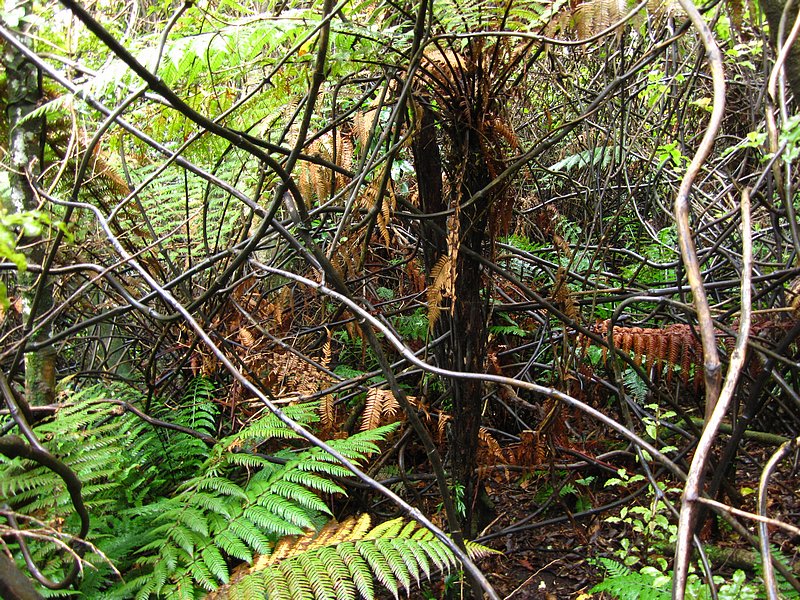
Supplejack tangle: There's a penguin in there somewhere.

Supplejack tangle: There’s a penguin in there somewhere

To the uninitiated, counting penguins seems like ‘a walk in the park’.  Instead it can be a dirty, frustrating and physically demanding task.  Yellow-eyed penguins nest in forest, ususally with their backs to a tree or in dense vegetation and up to 500m inland.  Finding them means starting at their landing point and following the often subtle signs of a penguin track, ocassionally dotted with tell-tale penguin poop.  Unlike us somewhat taller humans, penguins have no trouble negotiating the thick vegetation and seem to take delight in detouring through the thickest supplejack patches on the way to their nests, sometimes necessitating a hands and knees approach.  The smell of seabird poop can alert the searcher that a nest is nearby and then close inspection of all likely looking hollows and thickets is required.

Once found, the nest is checked for eggs, the attending bird is checked for a flipper band or transponder and the nest marked by GPS and flagging tape so that the nest can be revisited later in the season to determine breeding success.

What’s going on?

Dean checking a nesting bird for a transponder

Dean checking a nesting bird for a transponder

Yellow-eyed penguins are long-lived (Dean just found a couple of  birds he banded as chicks 20 years ago) and Codfish island is predator-free, so why isn’t it a penguin paradise?  Despite good breeding success in most years, first-year survival of penguins can be very low in years when food resources are low.  It seems that Codfish has experienced several of these poor years in recent times, meaning that few young birds have survived to enter the breeding population.

While adults are safe on their island sanctuary, at sea they are vulnerable to predators (mainly sharks) and by  enganglement with nets set for rig and elephant fish (species most often encountered in your fish-and-chip shop). The extent of this at-sea mortality is not well understood.

And in news just in…

Dean has just emerged from the bush having found 39 nests, no change on last year (read his search dairy here).  While not great news, it does confirm that last year’s low count was not a ‘one off’ low count and that something is really going on here.  The continued absence of  juvenile birds suggests ongoing unfavourable marine conditions.  Hopefully next year’s count will start to show a positive trend.

Yellow-eyed penguins at sea

Yellow-eyed penguins at sea

The Supporters of  wildlife sanctuary Tiritiri Matangi (SOTM), an island conservation have launched the Growing Minds programme, aimed at bringing more school children to Tiritiri Matangi Island for the day.

With help of the Auckland Business community, Growing Minds give children – particularly those from lower decile schools – the opportunity to experience a day out on Tiritiri Matangi and see how every person can make a difference to conservation.

Students investigating the rocky shore on Tiritiri Matangi.

Students investigating the rocky shore on Tiritiri Matangi

Running Events, an Auckland based event management company, has provided generous sponsorship for Growing Minds’ first year. Its 2013 events—the Westfield Albany Lakes Summer Series and Skechers Coatesville Classic—will be 100% non-profit and staff will work for six months for free to guarantee at least $25,000 for Growing Minds.

This will mean a day out on Tiritiri Matangi for at least 1,000 kids during the first year of the Growing Minds programme. Each child will travel free, receive a drink bottle to take home with them, and their school will be given a further $5 per child to go towards their lunch for the day. Ferry company 360 Discovery is also partnering with the programme, funding the accompanying teachers and adults at a ration of one free adult to six children.

Kids reading a sign board on Tiritiri Matangi.

Kids reading a sign board on Tiritiri Matangi

Greg the takahe gives ranger Jennifer Haslam a hand with the introductory talk on Tiritiri Matangi.

Greg the takahe gives ranger Jennifer Haslam a hand with the introductory talk on Tiritiri Matangi

Originally cleared for farming, the Tiritiri Matangi Scientific Reserve (Open Sanctuary) is now the site of one of the most successful conservation projects in the world. SOTM, a non-profit conservation volunteer group which formed in 1988, is a major contributor to the success of the island as an open sanctuary.

Since 1984 thousands of people have volunteered their labour or donated money to the project. Over 280,000 trees were planted by volunteers between 1984 and 1994. Most replanted areas are now well established and the island is home to many of our endangered birds including hihi, kokako, takahe and tieke. Volunteer work has shifted to tasks such as bird monitoring, translocations, guiding and inspiring the many visitors to the island, and working with schools through conservation education.

Kids fascinated by takahe up close.

Kids fascinated by a takahe

The Growing Minds programme is a great example of how a community group and local business are working in partnership to achieve more for conservation than DOC can do alone. For many of the children participating in the programme, it will be their first boat trip, let alone their first trip to a conservation island. Without the programme many children may never have the chance to see this inspiring “conservation in action”.

Red Beach Primary School students at the Tiritiri Matangi Visitors Centre.

Red Beach Primary School students at the Tiritiri Matangi Visitors Centre

For more information on the Growing Minds programme go to www.tiritirimatangi.org.nz/school-visits.

For more information on Running Events’ run and walk events go to www.albanylakes.co.nz and www.coatesvilleclassic.co.nz.